Round-up
Best ATS software for in-house teams (2026)
For an in-house SMB hiring for its own team, Breezy HR is the best all-round ATS in 2026: a fast, visual pipeline with a free plan a non-HR team can run on day one. Choose Workable for the widest sourcing reach, and Tellent when several people hire together.
The best ATS software for in-house teams, ranked
For most small in-house teams hiring for their own company, Breezy HR is the best all-round ATS in 2026: a fast, visual pipeline a non-HR team can run on day one, with a free plan to start (see plans). Workable wins if your priority is sourcing reach, getting a role in front of the widest pool quickly. Tellent (formerly Recruitee) is the pick when several people hire a role together and you want shared, structured pipelines. The full table is below, then a hands-on take on each.
Most pages ranking for this search are written by ATS vendors ranking themselves first. I don’t sell an ATS: I test them with my own accounts and money, and this list leads with the two I’ve actually run to a hire. If you’re the founder, office manager or team lead who got handed hiring and you’re not a recruiter, that’s exactly who this is for.
Job seeker who landed here after an ATS screened your application? This round-up is for the teams running one, not the candidates going through it. What these systems do with your CV is covered in our plain-English guide to applicant tracking systems.
This round-up is scoped to companies hiring for themselves, a startup or SMB filling its own roles, not recruiting agencies placing candidates for clients. If you run an agency the trade-offs are different (you need a client CRM, not just a candidate pipeline), so see Best ATS for staffing & recruiting agencies instead. And if you’re here because Freshworks is retiring Freshteam, start with the best Freshteam alternatives, where the picks are mapped to the part of Freshteam you’re replacing.
Our #1 pick is tested hands-on. Here is Breezy’s visual pipeline from the real role I ran through it, the day-one simplicity that puts it top of this list:
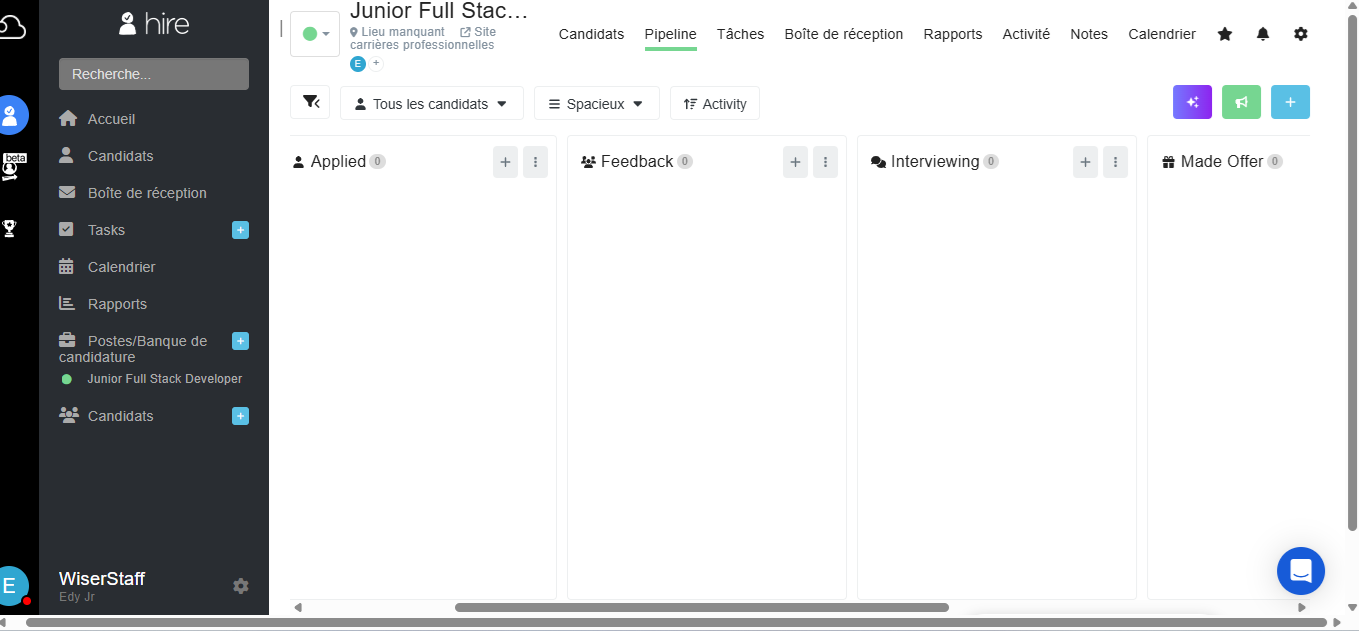
The full hands-on write-up, pricing and score are in the Breezy HR review.
At a glance: in-house ATS compared
The table is the decision surface. Prices are deliberately left as a tested figure rather than a vendor’s headline number. Every price below is filled in only after a real trial, with the date it was checked.
| Tool | Best for | Ease of setup | Free tier / trial | Tested price |
|---|---|---|---|---|
| Breezy HR | Best overall for in-house teams | Very easy | Free plan | $189/mo flat ($157 annual) |
| Workable | Best sourcing reach | Moderate | Trial | tested figure pending |
| Tellent | Best for collaborative hiring | Easy | Trial | tested figure pending |
| Manatal | Best AI sourcing on a budget | Easy | Trial | $19/user/mo ($15 annual) |
| JazzHR | Best for a tight budget | Easy | Trial | tested figure pending |
How I tested these
I rank tools by running a real in-house hiring workflow through each one: posting a role, sourcing and parsing candidates, moving them through stages with a hiring manager, and sending an offer. Numeric scores appear only after that hands-on test: a tool I haven’t finished testing shows “Review in progress” instead of a score, and its place in this list is provisional, drawn from documented features and pricing rather than my own run. I buy or trial each tool on my own accounts, and the affiliate links here never change the ranking; the disclosure sits above this content.
For this round-up I have tested Manatal and Breezy hands-on: I posted a real junior full-stack developer role, sourced and triaged candidates in each, and ran Breezy’s through to a hire (21 candidates identified, 1 hired, 3 disqualified), in June and July 2026. Tellent has since been tested too, on a lighter run (a published role and a sample-candidate pipeline, scored 8/10 with that scope stated). Workable and JazzHR keep a “Review in progress” note until the same role has run through each.
Breezy HR: best overall for in-house teams
Breezy HR is the best choice for a small team that wants a working pipeline on day one without a setup project. It is the friendliest ATS here: a visual, drag-and-drop pipeline a non-technical team can run on its first day, plus a free plan to start. At a small company the person running hiring is usually a founder, an office manager, or a team lead rather than a recruiter, so that low setup cost matters more than any feature checklist.
It’s my top pick because it does the core job (candidates moving through clear stages, with a careers page and scheduling) without a setup project or a per-feature upsell.
Tested (Jul 2026): 9/10. I posted a real role, activated it (Breezy queued it to 50+ free job boards within 24 hours), and ran candidates to a hire. The free Bootstrap plan runs one active position at a time; the first paid tier, Startup, is $189/mo ($157 billed annually) and lifts that to unlimited positions at a flat rate with unlimited users, so the belief that Breezy charges per open role only holds on the free plan. The one genuine annoyance: the AI candidate scores sat blank until I realised Breezy Intelligence is a separate paid add-on, not part of the plan. Full detail in the Breezy HR review.
One honest caution the vendor pages won’t give you: buyers who need real numbers out of an ATS find Breezy thin. A Group Director of Recruitment rates it 2/5 on Capterra for “poor UX, not intuitive, lack of reporting or data” (Capterra), and weak reporting is the single most common gripe across small-team ATS tools. If you’ll have to hand a hiring manager a dashboard, test the reports before you commit.
Choose Breezy HR if you want an easy, visual pipeline your team can run on day one. → See Breezy HR
Workable: best for sourcing reach
Workable is the best pick when getting enough applicants is the bottleneck, not tracking them. Its strength is reach: it posts to a large number of job boards at once and has solid AI-assisted sourcing, which helps an in-house team build a big applicant pool quickly when a role is urgent. For a company that needs to fill a seat fast and has no recruiter working their network, that wider reach is worth paying for.
The common knock is price. It can run more expensive than the others here as you add what you need, so weigh the sourcing reach against the cost for your hiring volume.
Until the same real role has run through Workable it stays unscored here, listed on documented reach and pricing only. Already on Workable and finding that its headcount-based bill doesn’t match how often you hire? The Workable alternatives round-up maps the tested exits.
Choose Workable if wide sourcing reach is worth a higher price. → See Workable
Tellent: best for collaborative hiring
Tellent is the best pick when hiring at your company is a team sport rather than one person’s job. It is a modern, collaborative hiring platform built around bringing recruiters and hiring managers into one shared space. For an in-house team where the manager who owns the role and whoever runs hiring need to work it together, leaving feedback, moving candidates, comparing notes, that shared, structured pipeline is the point.
Now tested at 8/10 in the full Tellent review: fast to stand up, a genuinely pleasant pipeline, with demo-gated pricing as the main catch. Choose Tellent if several people hire together and shared pipelines matter. → See Tellent
Manatal: best AI sourcing on a budget
Manatal is the best pick if you want AI candidate recommendations without paying enterprise rates. It is an AI-driven ATS aimed at SMBs: alongside the pipeline it adds candidate sourcing and AI recommendations at a price small teams can afford. For an in-house team that wants a bit of sourcing help, it gives you something you couldn’t otherwise justify. It’s also built with agencies in mind, so some CRM features will be more than an in-house team needs; the hands-on Manatal review has the detail.
In testing it scored 9/10. A real search returned 106 ranked matches with transparent scores (top two at 78% and 75%), useful for triaging a shortlist fast. It loses a point on integrations: automation and the API are locked to the upper plans, so on the entry plan it’s manual-only. From $19/user/mo ($15 billed annually), tested June 2026. If the AI layer is the main reason you’re shopping, the AI HR tools shortlist compares these tools by how they charge for it.
Choose Manatal if you want AI sourcing and tracking at an SMB price. → See Manatal
JazzHR: best for a tight budget
JazzHR is the best pick when cost decides it and you mainly need clean applicant tracking. It’s pitched at bootstrapped startups and small teams as a simpler, plan-based alternative to per-feature enterprise tools. It’s the budget pick rather than the all-rounder, because its interface is plainer than Breezy’s and its sourcing is lighter than Workable’s. For a team that just needs to track applicants cleanly, that can be all you want.
JazzHR hasn’t had its hands-on run yet, so it carries no score; the tested price will follow once the same role has run through it. Its published plans meter job postings rather than seats, and the JazzHR alternatives tear-down runs the real 2026 numbers and where the caps bite.
Choose JazzHR if you want a clean, affordable ATS with unlimited users on every plan. → See JazzHR
ATS or HRIS: which do you actually need?
An ATS handles hiring; an HRIS handles the people once they’re hired, meaning records, payroll, and time off. Most small teams don’t need both on day one. Start with an ATS for the pipeline and a payroll tool like Gusto for pay and contracts, then consolidate into an HRIS only when headcount and compliance reporting make it worth the heavier tool. The stretch between the two systems, turning a signed offer into a working employee, is covered in our week-by-week onboarding plan. If you’re mapping where hiring fits in the wider HR workflow, start with our HR automation guide.
What an ATS for small business actually costs
Most small-business ATS tools bill one of three ways, which is why a sticker price tells you little until you’ve been billed. The model matters more than the headline:
- Per active job. You pay for the number of roles open at once. Cheap when you hire in bursts, awkward if you always have several reqs live.
- Per user (or per seat). You pay for each person with a login. Predictable for a fixed hiring team, but the bill climbs as you pull more managers into the process.
- Flat monthly tier. One price for a band of usage, with limits on jobs or users baked in. Simple to budget, easy to outgrow. Breezy works this way: its free plan caps you at one active position, but every paid tier is a flat monthly price with unlimited positions and unlimited users. If the budget is $0 for now, the free applicant tracking software round-up maps which free tiers are genuine and where each one stops.
The model decides your bill more than the sticker does, and the gap widens with your hiring group. Worked through on the two tested picks, annual billing:
| Hiring users | Breezy Startup (flat, $157) | Manatal Professional ($15/user) |
|---|---|---|
| 3 | $157/mo | $45/mo |
| 10 | $157/mo | $150/mo |
| 25 | $157/mo | $375/mo |
Below roughly ten seats, per-user Manatal is cheaper; past it, Breezy’s flat line wins and keeps winning. Buy for where your team will be in a year, not where it is today. The two tested picks are compared dimension by dimension, on the same test role, in Manatal vs Breezy, tested side by side.
Headline prices mislead because they quote the cheapest tier before add-ons, and because the billing model decides whether that tier actually fits how you hire. That’s why every figure on this page is a price we were billed, on a dated test, rather than a number copied from a pricing page. Until a tool is tested, its cell stays empty on purpose. For the same treatment across payroll, HR and global-hiring tools, the HR software pricing index collects every tested and published 2026 figure with its model and source.
How to choose the right ATS for your team
Pick by who runs hiring and where your bottleneck is, not by the feature grid. First, an honest gut-check: if you hire only a handful of people a year, you may not need a paid ATS at all yet, and a shared spreadsheet can carry you until hiring is frequent enough that candidates start slipping through. And if your company is a startup whose headcount will double this year, the startup-stage ATS picks weigh this same field against that growth curve instead of a steady state. Once you’re past that, four questions decide it for most in-house teams:
- How technical is the person running hiring? If it’s a founder or office manager with no recruiting background, Breezy’s day-one simplicity wins. A more hands-on team can absorb Workable’s depth.
- Is speed-to-fill or quality-of-pool the bottleneck? If you struggle to get enough applicants, Workable’s job-board reach earns its price. If you get enough candidates but lose track of them, a cleaner pipeline (Breezy or Tellent) fixes that.
- How many people hire together? A solo hiring owner is fine with Breezy or JazzHR. A role worked by a manager and a recruiter gets real value from Tellent’s shared spaces.
- How tight is the budget? JazzHR and Breezy’s free plan let you start cheap; Workable sits at the higher end. Decide what you’ll pay after you trial, using the tested figure, not the headline price.
- Buying for a small business where hiring is a side duty? The tested ATS picks for small businesses rank this field for exactly that shape, down to the seat-count where flat pricing starts winning.
One more check if you hire in the US: confirm the ATS supports EEOC and EEO-1 data handling, and for roles in New York City that it helps you meet Local Law 144, which requires a bias audit when an automated tool screens candidates. These are real legal obligations a sourcing-first tool can quietly leave on you.
Before you commit, trial your top two and run one real role through each, from posting to offer, then compare what each actually charged you. A price you’ve been billed tells you far more than any number on a vendor’s pricing page.
FAQ
What is the best ATS software for a small in-house team?
For most small in-house teams hiring for themselves, Breezy HR is the best all-round pick: a visual, drag-and-drop pipeline a non-HR team can run on day one, with a free plan to start. If you need the widest sourcing reach, Workable casts a bigger net; if several people hire together, Tellent is built around shared, collaborative pipelines.
What's the difference between an ATS and an HRIS?
An ATS (applicant tracking system) manages hiring: sourcing, tracking, and moving candidates through stages up to an offer. An HRIS manages people once they're employed, covering records, payroll, time off, and reviews. Small teams often start with an ATS for hiring and a payroll tool like Gusto for the rest, then consolidate into an HRIS later. See our guide on what HR processes you can automate.
Is there a genuinely free ATS for small businesses?
Yes. Breezy HR has a free plan and Tellent and Workable offer free trials, so you can run a real role through each before paying. Free tiers usually cap active jobs or users, so treat them as a way to test fit, not a permanent plan once you hire regularly. We publish the price we actually paid at the date we tested it, not the headline number.
Do I need an ATS if I only hire a few people a year?
Probably not a paid one. If you hire only a handful of people a year, a shared spreadsheet and a clear checklist can be enough. An ATS earns its place once hiring is frequent enough that candidates fall through the cracks, or enough people are involved that nobody owns the whole pipeline. Measure your own time-per-hire first, then decide.