Round-up
Best Workable alternatives (2026): tested picks by hiring volume
The best Workable alternative for a team that hires now and then is Breezy HR: a visual pipeline, a genuinely free starter plan and flat pricing at $189/mo. Manatal adds AI sourcing from $19/user/mo. Workable itself prices by total company headcount, from $299 a month, which punishes occasional hiring.
The best Workable alternatives by hiring volume
The best Workable alternative depends on how much hiring you actually do. For a team that hires now and then, Breezy HR is the tested pick: free to start, flat-priced after that (see plans), and simple enough that nobody needs a recruiting background. If you also want help finding candidates, not just tracking them, Manatal pairs AI sourcing with a recruitment CRM at per-user pricing. Workable is a capable ATS; the reason teams leave is its pricing shape, which bills you by total company headcount whether you hire monthly or twice a year.
Most pages ranking for this search are written by ATS vendors nominating themselves. I don’t sell an ATS. This round-up leads with the two tools I’ve tested hands-on, then names four credible candidates I haven’t, with no invented scores.
Job seeker trying to get past an ATS? This page is for the employers running one. What these systems actually do with your CV is covered in the glossary entry on what an ATS is.
Why teams look past Workable
Workable is a recruiting platform and applicant tracking system (ATS) that posts jobs to multiple boards in one step, tracks candidates through hiring stages, and bundles a sourcing database with HR basics. It earns its reputation: every plan carries unlimited active jobs, and the product has been around long enough to have sanded off most rough edges. The buyer voice reflects that faint praise, though. A corporate recruiter who moved their startup off a clunkier system put it this way on Reddit: Workable is “meh but 1000x faster” than what it replaced, and that for light hiring, keeping track in Excel “is all you need.” When the honest competition is a spreadsheet, the tool has to justify every dollar.
That’s where the shape problem starts. Three patterns push teams to this page:
- You pay for headcount, not hiring. Workable’s price is set by your company’s total employee count, in tiers from 1–20 up to 1,000+. Grow the company without growing your hiring, and the ATS bill rises anyway.
- The add-on stack. On the Standard plan, texting, video interviews and assessments are separate line items (see the table below). The advertised price and the working price are different numbers.
- Occasional hiring can’t amortise it. At $299 a month billed annually, a team that fills five roles a year is paying $718 per hire in software alone ($3,588 spread over five hires) for a system that sits idle between bursts.
All three are the economics of a platform built for continuous hiring, landing on teams that hire in bursts. The fix is matching the pricing model to your hiring volume, which is how the picks below are organised.
What Workable actually costs in 2026
Workable publishes its prices, which deserves credit; what the ranking pages skip is the structure. All figures below are from Workable’s pricing page, checked July 2026, for the smallest company tier (1–20 employees). Prices increase with headcount.
| Plan | Price (annual billing) | Per year | What the tier means |
|---|---|---|---|
| Standard | $299/mo | $3,588 | ATS, sourcing, unlimited active jobs, HRIS basics |
| Premier | $599/mo | $7,188 | Adds texting, video interviews, assessments built in |
| Enterprise | $719/mo | $8,628 | Adds enterprise controls |
| Texting (add-on) | +$89/mo | — | Paid extra on Standard |
| Video interviews (add-on) | +$109/mo | — | Paid extra on Standard |
| Assessments (add-on) | +$59/mo | — | Paid extra on Standard |
Month-to-month billing costs more; Workable frames annual billing as a 20% saving. Its AI agent features run on credits: 3,000 are included, and top-ups start at $600 for 5,000 credits, which expire after a year. A Standard subscriber who wants texting, video and assessments is looking at $556 a month before headcount growth, at which point Premier is the obvious upsell. That ladder is the design.
Who should stay on Workable
If you hire continuously, run several roles at once all year, and use the sourcing database and multi-language careers pages, Workable’s per-headcount pricing spreads across enough activity to be fair, and its unlimited active jobs beat per-position pricing at volume. A 100-person company with a standing talent function shouldn’t read this page as a push to leave. The alternatives below are for the other buyer: the founder, office manager or ops lead who is not a recruiter, hires in bursts, and keeps paying a platform bill shaped for someone else.
How I chose these
I only score tools I’ve tested with my own account, so this list splits in two. Breezy HR, Manatal and now Tellent carry tested verdicts from their own hands-on reviews; the process is documented in how WiserStaff tests tools. Greenhouse, Zoho Recruit and JazzHR are credible candidates I haven’t run, so they appear without scores or invented prices. Affiliate links are disclosed above this content and never change a ranking; the three untested tools carry no affiliate relationship at all.
Pick by how you actually hire
Hiring now and then → Breezy HR
For the occasional hirer, Breezy solves the two problems Workable creates: it’s free to start, and its paid pricing follows active positions, not company headcount. The Kanban pipeline is the whole product philosophy: drag candidates between stages, automate the acknowledgement emails, post once to 50+ job boards. Nobody on your team needs to have run a req before.
Tested (Jul 2026): 9/10. The free Bootstrap plan runs one active position with unlimited users. The Startup tier is $189/mo flat ($157 billed annually) with unlimited positions. AI scoring and the API cost extra, and reporting is serviceable rather than deep. Full detail in the Breezy HR review. → See Breezy HR
One thing I checked specifically, because it’s the first thing your boss asks: what the reporting can show. Here’s the real dashboard from my test role, 21 candidates in.
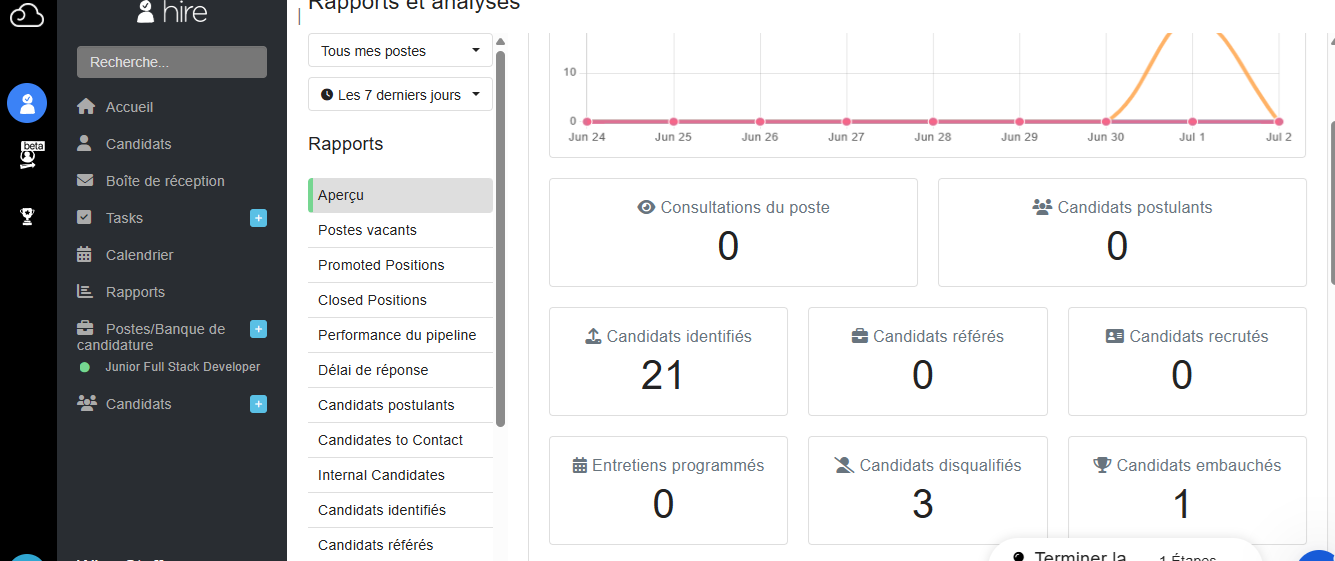
It answers “how’s the hiring going?” in one screen. It won’t do cohort analysis, and I’ve said so in the full review; for a team hiring in bursts, that trade against a $299 floor is easy.
Hiring plus sourcing → Manatal
If your real frustration with Workable is paying platform money while still hunting candidates manually, Manatal is the pick. It pairs tracking with AI candidate recommendations scored against each job, plus a recruitment CRM, at a per-user price that suits a team where only one or two people ever touch the ATS.
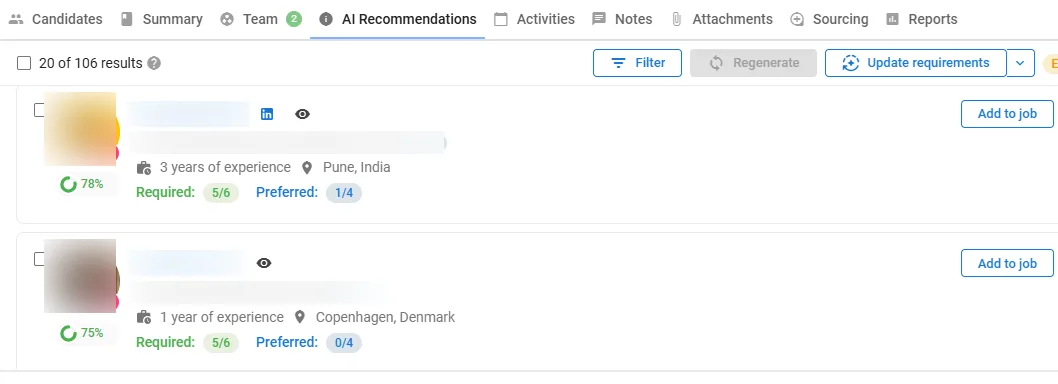
Tested (Jul 2026): 9/10. From $19/user/mo ($15 billed annually) on Professional. In my test the AI search surfaced 106 scored matches for one role, with the scoring visible rather than black-box. Automation and the API sit on upper plans. Full detail in the Manatal review. → See Manatal
Candidate experience matters here too: both picks keep application forms short and send acknowledgements automatically, which is where slow-moving inboxes lose good applicants. If you’re weighing more ATS options beyond a Workable exit, the in-house ATS shortlist ranks the wider field; recruiting and staffing agencies, whose economics are different, have their own agency-side ATS picks.
At a glance: Workable alternatives compared
Prices are the real, dated figures from the tools I’ve reviewed; untested tools show no price and no score on purpose.
| Tool | Pricing model | Free plan | Tested price | My status |
|---|---|---|---|---|
| Breezy HR | Flat, by active positions | Yes (1 position) | $189/mo flat ($157 annual) | Tested 9/10 |
| Manatal | Per user | Trial | $19/user/mo ($15 annual) | Tested 9/10 |
| Greenhouse | Quote-based | No | not tested | Not yet tested |
| Tellent | By employee count | Trial | demo-gated | Tested 8/10 |
| Zoho Recruit | Per user | Yes (free tier) | not tested | Not yet tested |
| JazzHR | Flat tiers | Trial | not tested | Not yet tested |
| Workable (baseline) | Company headcount | No | $299/mo (1–20 employees, Jul 2026) | Baseline |
Still on my list to test
Credible candidates I haven’t run myself, so no scores and no unverified prices.
Greenhouse
The step up rather than the step sideways: structured interview kits, scorecards and hiring analytics built for a dedicated talent function. It’s the name that kept appearing alongside Workable in the real buyer shortlists I collected for this niche. Two honest cautions: it’s quote-priced, and even its fans grumble; one recruiter’s verdict on the redesign was blunt about the reporting. If you’re leaving Workable over cost or overkill, Greenhouse is likely more of both; its buyer-reported contract costs and the documented exits are printed in the tested Greenhouse alternatives page.
Tellent
Tellent (formerly Recruitee) is a collaborative-hiring ATS built around shared pipelines and scorecards. One correction from testing it: its pricing now scales by your company’s employee count, per its own plan pages, and every tier is demo-gated, so no figures here. Tested hands-on at 8/10 in the Tellent review: fast to stand up, with the Start tier capped at 5 active job posts, a fit most occasional hirers won’t outgrow quickly.
Zoho Recruit
The budget route, with a genuine free tier and a separate staffing-agency edition. Strongest if you already live inside the Zoho suite.
JazzHR
Plain, affordable applicant tracking pitched at bootstrapped teams. Priced by job postings rather than seats, lighter on sourcing than Manatal and lighter on polish than Breezy, but it does the core job at a low entry price; the tested JazzHR alternatives page breaks down its published 2026 plans.
How to switch without losing your applicant flow
The part most likely to break when you leave Workable is applicant reach, not data export. Your jobs are currently syndicated to boards through Workable’s integrations, and that pipeline doesn’t move with you. One talent-acquisition lead on Reddit reported applicants per job falling from roughly 200 on average in 2024 to barely 100 in 2025 after their ATS migration. They only caught it because they tracked the number. Four steps protect that flow:
- Map your applicant sources first. Pull the source report in Workable and write down where applicants actually come from, per role. This list is your migration checklist.
- Export everything while access is live. Candidates, notes, and the reports you’ll want for year-on-year comparisons. Confirm formats in Workable’s own docs rather than assuming attachments transfer.
- Re-verify every job-board connection on the new ATS. Post a test role and check it appears on each board from step 1. Free syndication lists differ between platforms.
- Run one hiring cycle in parallel, watching applicants per job. Keep Workable read-only through one full cycle on the new system, and compare applicant counts against your old baseline, not against zero.
Time it to your renewal date. Workable’s annual billing means a mid-term exit is money burned, and the Freshteam shutdown guide covers the same parallel-run playbook for teams migrating under a harder deadline.
Which alternative should you choose?
Match the pricing model to your hiring volume. Hiring in bursts points to Breezy HR: free to start, $189 a month flat when you outgrow that, no headcount maths. Add Manatal when sourcing is half the job and $19 per user beats platform pricing. Stay on Workable if you hire all year round, and whatever you choose, migrate with your applicant-source list in hand. If the real requirement is paying nothing at all, genuinely free ATS plans, compared covers that field, trials excluded.
For where an ATS sits in a wider automated HR stack, see what HR automation covers.
FAQ
How much does Workable cost in 2026?
Workable's Standard plan is $299 a month billed annually ($3,588/year) for a company of 1 to 20 employees, checked on Workable's pricing page in July 2026. Premier is $599 a month ($7,188/year) and Enterprise $719 a month ($8,628/year). Prices rise with total company headcount, and month-to-month billing costs more: Workable puts the annual saving at 20%. On Standard, texting ($89/mo), video interviews ($109/mo) and assessments ($59/mo) are paid add-ons.
Does Workable have a free plan?
No. Workable's pricing page lists paid tiers only, starting at $299 a month billed annually (checked July 2026). If a free plan is the requirement, Breezy HR's Bootstrap plan runs one active position free with unlimited users, and Zoho Recruit also has a free tier. Both are covered in this round-up.
Is Workable a good ATS?
Yes, on capability: strong job-board syndication, unlimited active jobs on every plan and a mature feature set. The complaints that push teams to look elsewhere are about shape rather than quality: pricing scales with total company headcount rather than hiring activity, and useful extras sit behind add-on fees on the Standard plan. One corporate recruiter on Reddit summed it up as 'meh but 1000x faster' than their previous system.
What is the cheapest Workable alternative?
Breezy HR's free Bootstrap plan is the cheapest way off Workable if you run one role at a time; its first paid tier is $189 a month flat ($157 billed annually) with unlimited positions. Manatal starts at $19 per user per month ($15 billed annually), which lands far below Workable's $299-a-month floor for a team of one or two hiring users. Zoho Recruit's free tier is the other genuine zero-cost option.
Is Breezy HR better than Workable?
For occasional hiring, usually yes: Breezy is priced flat per active positions rather than by company headcount, has a real free plan, and its Kanban pipeline needs no recruiting background. Workable is stronger for continuous, structured hiring at scale, with deeper sourcing and unlimited active jobs. I've tested Breezy hands-on (9/10); the deciding question is whether you hire in bursts or all year round.
Why do applications sometimes drop after switching ATS?
Because job-board connections don't move automatically. Each ATS syndicates roles to boards under its own integrations, and a switch can quietly break that reach. One talent-acquisition lead on Reddit reported average applicants per job falling from roughly 200 in 2024 to barely 100 in 2025 after an ATS migration. Before leaving Workable, list where your jobs actually get seen, and re-verify each source on the new system.