Review
Tellent (formerly Recruitee) review (2026): tested hands-on
Tellent (formerly Recruitee) is a collaborative-hiring applicant tracking system I tested on a real trial account: publishing a live job, building a pipeline, and working its analytics and marketplace. It scores 8/10: a polished, fast ATS with strong GDPR tooling, held back by demo-gated pricing, preset-card reporting, and a collaboration layer I could not fully exercise solo.
Pros
- Genuinely fast setup: real trial account to published job in one sitting, no credit card
- Customisable Kanban pipelines that are pleasant to run: drag-and-drop stages, qualified/disqualified split, per-stage counts
- 200+ integration marketplace (job boards, HRIS, assessments, e-signature), browsed first-hand
- AI now included in the plan grid: email and feedback writing from the Start tier, Screening and Matching assistants above it
- GDPR baked in: candidate consent, right-to-be-forgotten and retention automation, strong for EU/UK hiring
Cons
- No public pricing: every plan is demo-gated with no dollar figure, on the public page and from inside the trial
- Analytics is a set of preset report cards (published/filled/fill-rate), confirmed in my test; deep custom reporting isn't the product's shape
- The collaborative-hiring core (shared scorecards, team feedback) needs a real team to exercise; I could not fully test it solo
- Assessments, video interviewing and e-signatures are integration- or add-on-only; onboarding lives in the paid Journeys add-on
- Start tier caps at 5 active job posts; unlimited posts start at Advance
Is Tellent worth it?
Tellent is the ATS that used to be called Recruitee, and the product still carries that name in the app. I ran it on a real 18-day trial account: created the workspace, published a live job (Associate Full Stack Developer, ref #ua5p9, Amsterdam/remote), built out its pipeline with a set of sample candidates, and worked through the analytics, talent pools and integration marketplace. On that run it scores 8/10: a genuinely polished, fast ATS with the best integration surface I’ve browsed in this price class, held back by pricing you cannot see without a demo and a collaboration layer that needs a real team to prove.
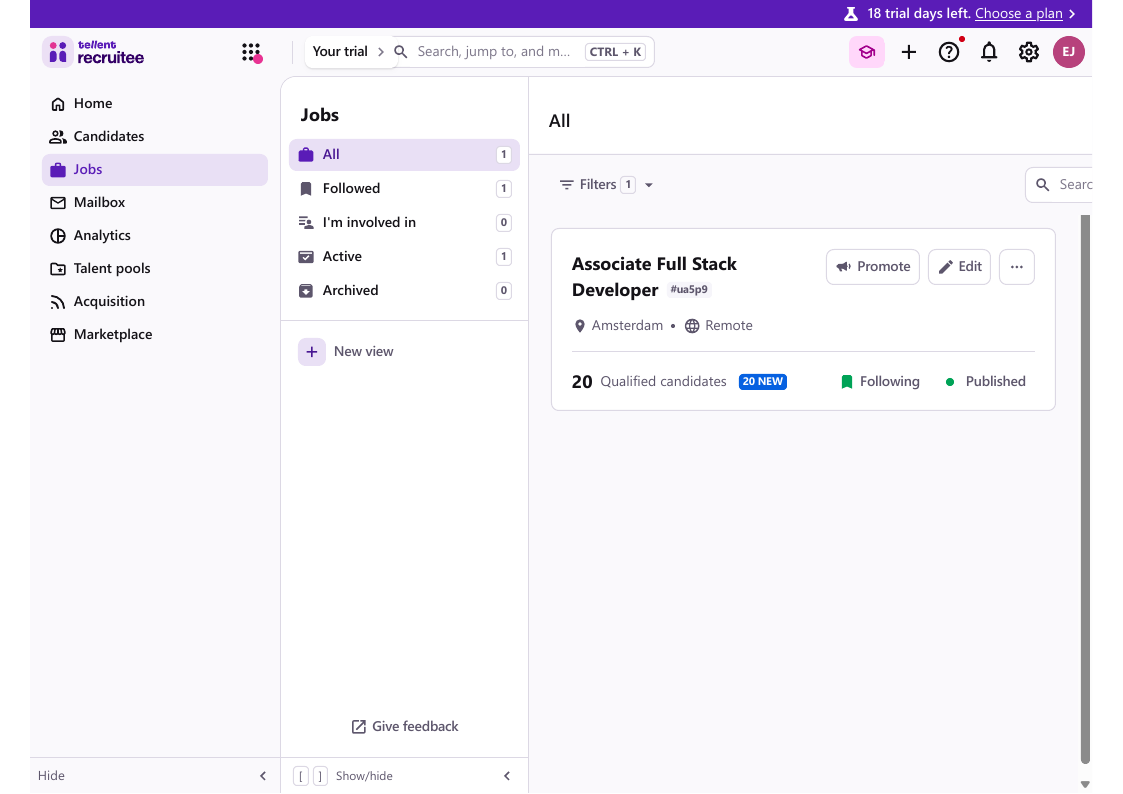
What I could and couldn’t test. I published a real job and ran the pipeline with sample candidates I added myself, not live applicants, so candidate-facing flows (careers-site applications, email threads) went unexercised. The collaborative core, shared scorecards and a second evaluator’s feedback, is built for a team and I tested solo, so I’m scoring the mechanics I ran, not the teamwork I couldn’t. And no price was verified: every plan stayed behind a demo, so this 8/10 rates usability and pipeline mechanics rather than confirmed value for the price. Where those gaps matter below, I say so and lean on documented behaviour plus independent reviews.
What is Tellent?
Tellent (formerly Recruitee) is a collaborative-hiring applicant tracking system (ATS) aimed at small and mid-sized teams, roughly 20 to 250 people. It’s built around bringing recruiters and hiring managers into one shared space: customisable pipelines, shared candidate scorecards, and a careers-page builder for employer branding. The product launched as Recruitee in 2015 in Amsterdam and is now part of Tellent, the parent brand that also runs Javelo and KiwiHR (SelectSoftware Reviews).
Who it’s built for
- Growing in-house teams where hiring managers are actively involved, not just the recruiter.
- Companies that care about employer branding and want a polished, SEO-friendly careers page.
- EU/UK teams that need GDPR consent and retention handled properly.
Who should look elsewhere
- Teams that need deep, custom reporting: what I found in the Analytics module is preset report cards, not a report builder.
- Teams wanting native assessments, video interviews or e-signatures (integrations), or onboarding without the paid Journeys add-on.
- Anyone who needs transparent, self-serve pricing or a true monthly plan; the flat-priced Breezy HR is the tested counter-example.
What the test run looked like
Sign-up to published job took one sitting, with no credit card. The job editor is clean: title, location (mine ran Amsterdam plus remote), description blocks, and a Publish action that took the role live with a shareable careers link and a reference tag. From there the Kanban pipeline is the daily surface: I ran stages from Applied through Phone interview, On-site interview, Evaluation and Offer, dragging candidates between columns, with qualified/disqualified counts kept at the top. The board is fast and legible, and per-stage counts update as you move people.
The honest caveat: those were sample candidates I added, not inbound applicants, so I can vouch for how the pipeline handles and moves records, and not for parsing quality on real CVs or the candidate’s side of the emails. The Talent pools and Acquisition sections exist for sourcing beyond a single role; I opened them but ran no sourcing campaign. Saying where a run stopped is part of the rubric this one was scored against.
Collaborative hiring: the pitch I couldn’t fully test
Tellent’s differentiator is the team around the hire: shared scorecards and evaluation forms, notes with @-mentions, and role-based permissions that control who sees what. That machinery is visible throughout the product, and it is exactly the part a solo trial cannot prove: structured feedback only earns its keep when a second evaluator actually responds. Independent reviewers repeat one warning worth keeping: on teams where hiring managers go quiet, the feedback loop becomes a bottleneck rather than a speed-up. I’m flagging this as documented strength, untested by me, and it’s a point I’ll revisit if I run a team through it. If structured, multi-evaluator hiring at enterprise depth is the bar you’re measuring against, the the Greenhouse-tier ATS alternatives maps that end of the market, with Tellent as its lighter tested match.
Reporting: preset cards, confirmed
The recurring third-party complaint about this product is shallow reporting, and my run supports the shape of it. The Analytics module is organised as preset report groups (Jobs, Candidates, Pipelines, Disqualifications, Hires, Interviews, Evaluations, Careers site), each a set of tiles: jobs published, filled, closed, fill rate, time to fill.
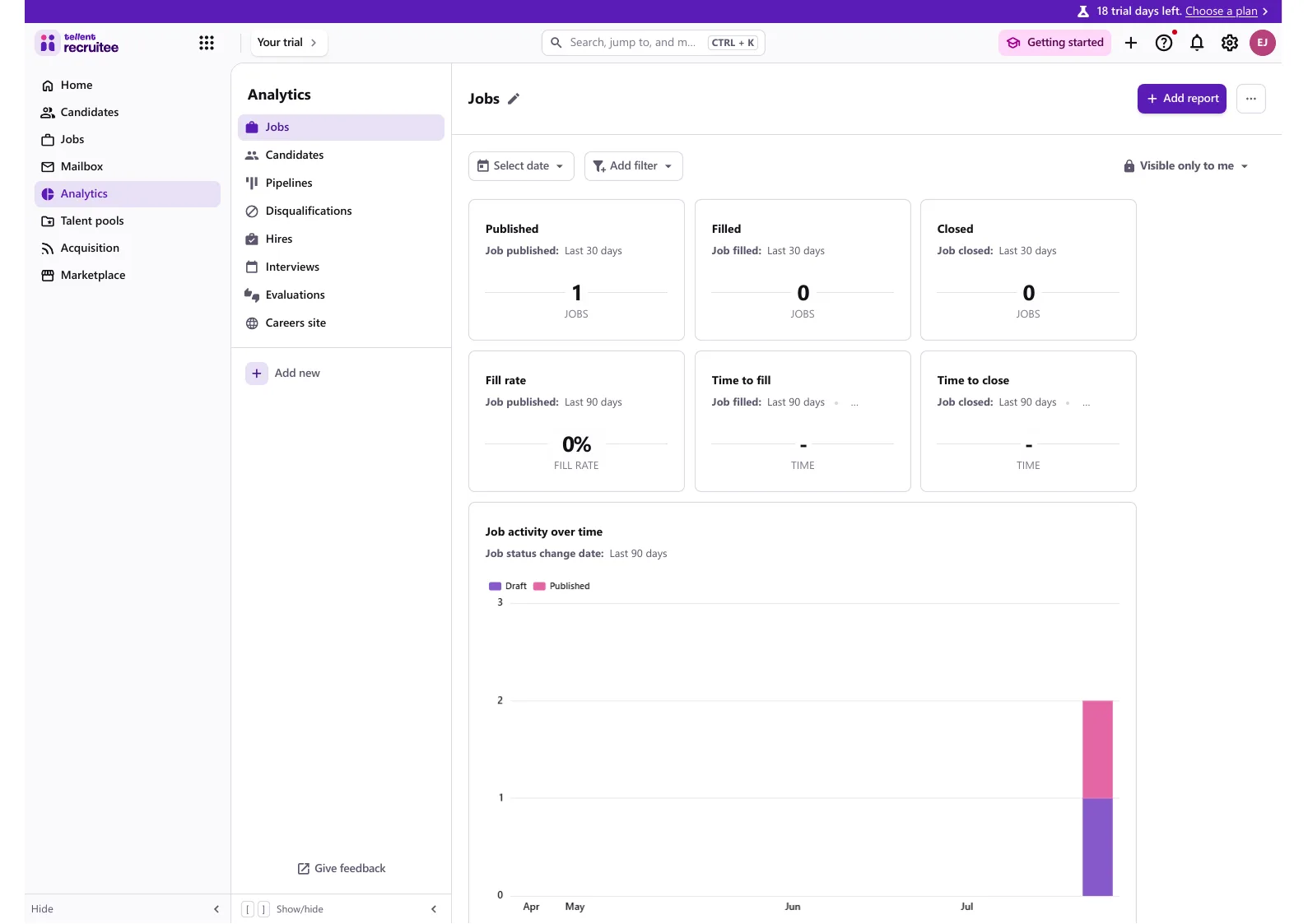
The tiles are clear and would serve a small team’s weekly review fine. What I did not find is a report builder for arbitrary custom questions, and reviewers add that data exports can exclude notes. If your hiring runs on bespoke reporting, weigh this section heavily.
Integrations and the marketplace
This was a genuine strong point of the run. The in-app Marketplace lists 200+ integrations across job boards (Google for Jobs, Indeed Apply, LinkedIn and XING apply flows, Talent.com), HRIS (Personio, BambooHR, and Tellent’s own HR product), assessments, e-signatures, SSO, onboarding (Appical) and texting/WhatsApp. Two came activated on the trial out of the box. The pattern to budget for: assessments, video interviewing and e-signatures arrive through these integrations rather than natively, and (pre)onboarding lives in Tellent’s paid Journeys add-on.
GDPR and data compliance
For EU and UK hiring, Tellent’s compliance tooling is a genuine strength: candidate consent management, right-to-be-forgotten handling, and retention automation are built in rather than bolted on. If you process EU or UK candidate data, that baked-in handling of consent and deletion is one of the stronger reasons to shortlist it.
Pricing: what you’ll actually pay
Still the weakest part of the buying experience: Tellent doesn’t publish prices. Its pricing page (checked 22 July 2026) shows three tiers, Start / Advance / Optimize, each behind “Get a demo” with no dollar figure, and my trial’s upgrade path led to the same wall. What the plan grid does state, captured the same day: pricing is per company, scaling with employee count; Start includes 5 active job posts and a single-page careers site; Advance adds unlimited posts, multi-language, referrals, an AI Screening Assistant (100 credits/month) and AI Matching Assistant (3 searches/month); Optimize adds SSO, a dedicated CSM, full AI screening and 65 matching searches. Add-ons price separately: SSO, Texting, Journeys, AgencyHub, WhatsApp Hiring, and the Tellent HR HRIS. The 18-day free trial with no credit card is confirmed first-hand. Third-party sites report figures from around $199/mo upward, but they disagree and none is official; I won’t pin a number to this page until I’ve been quoted one. Every price this site has verified, with source and capture date, lives in the HR software pricing index.
Pros and cons, after testing
Strengths I saw: setup speed (account to published job in one sitting); a pipeline that’s genuinely pleasant to run; a clean job editor; a wide, well-organised integration marketplace; AI written into the plan grid from the bottom tier; GDPR tooling built in.
Weaknesses I saw or confirmed: analytics is preset cards, not a builder; pricing is invisible end to end; the Start tier’s 5-post cap arrives quickly for an active team; the collaboration promise needs a team to cash in.
For third-party context, the product holds 4.4/5 on G2 (around 450 reviews) and 4.4/5 on Capterra (194 reviews, Ease of Use 4.6) under the Recruitee name, and Tellent was named a Strong Performer in Fosway’s 2025 Talent Acquisition 9-Grid, all checked July 2026 (G2; Capterra). Tellent’s “7,000+ hiring teams” figure is company-wide across all its brands, not this ATS alone.
Tellent review FAQ
How much does Tellent cost, and why isn’t pricing public? Tellent doesn’t publish prices: its three tiers (Start, Advance, Optimize) are demo-gated on the public page, and the trial’s upgrade path leads to the same demo wall. Pricing is per company and scales with employee count. Third-party sites report figures from around $199/mo upward, but they disagree, so get a real quote for your team size.
Does Tellent have a free trial? Yes, and I used it: 18 days, no credit card required, with enough unlocked to publish a real job, run a pipeline, and browse the full marketplace.
Is Tellent priced per user or per company? Per company. Plans are tiered by your company’s total employee count and billing period rather than charged per seat, so the bill tracks the size of the business, not the number of people working a role. Confirm the exact user terms on your quote, since the plan pages don’t spell them out.
Is Tellent good for collaborative hiring specifically? That’s its core pitch: shared scorecards, structured feedback, @-mentions and role-based permissions are built for teams hiring together. I tested solo, so I saw the machinery rather than the teamwork; the honest caveat from team users is that it only pays off if hiring managers actually respond to feedback requests.
Is Tellent the same as Recruitee? Yes. Recruitee is the original product and the app still carries the name; Tellent is the parent brand it now sits under, alongside Javelo (performance) and KiwiHR (HRIS).
Is Tellent GDPR-compliant? Yes. Candidate consent, right-to-be-forgotten and retention automation are built in, which makes it a strong fit for EU and UK hiring where those obligations apply.
The verdict
Tellent tests at 8/10. The product is fast, likeable and easy to stand up: I went from empty trial to a published job with a working pipeline in a single sitting, and the 200+ integration marketplace plus built-in GDPR tooling are real assets for an EU/UK-leaning team. It loses its points where the buying and proving get hard: a price you cannot learn without a sales call, reporting that stops at preset cards, and a collaborative core I could see but not fully exercise alone. If a second evaluator’s workflow and a real quote land well, this score has room to move up; the how WiserStaff tests tools method is the bar it was scored against. For where it sits among tested alternatives, start with best ATS software or the Zoho Recruit alternatives shortlist, and see what HR processes you can automate for the wider stack.