Review
Manatal review: AI applicant tracking system for SMBs & agencies
Manatal is an affordable AI-driven ATS for SMBs and recruiting agencies, pairing candidate sourcing and AI recommendations with a built-in recruitment CRM. In hands-on testing it scored 9/10: strong, fast AI sourcing at a low price, with one real catch — it gates automation and API access to the upper plans, so the entry plan is largely manual.
Pros
- Fast, transparent AI candidate scoring (match % with a required/preferred breakdown)
- Recruitment CRM layer for managing clients and candidate relationships
- Affordable: from $15/user/mo billed annually, well below enterprise platforms
- Social-media and LinkedIn sourcing via a browser extension
- GDPR, CCPA and PDPA compliance tools on every tier
Cons
- Automation, API and SSO are locked to the upper plans; the entry Professional plan is manual-only
- No direct posting to LinkedIn or Indeed: you post manually, then route applications back via a Manatal collection email
- AI parsing is tuned for English-language CVs; I tested it on an English role, so other-language accuracy is unverified here
- CRM depth sits below dedicated agency CRMs (Bullhorn, Recruit CRM) for high-volume desks
- Entry plan caps you at 15 open jobs and 10,000 candidates
Is Manatal worth it?
Manatal will rank 106 candidates for a role in seconds, then ask you to jump two pricing tiers to automate a single follow-up email. That tension is the whole review. Manatal is an affordable, AI-driven applicant tracking system for SMBs and recruiting agencies: alongside the hiring pipeline it adds candidate sourcing, AI recommendations and a recruitment CRM layer for client and candidate relationships, the combination a pure in-house ATS lacks. It suits a small team that wants sourcing and tracking in one tool. After a hands-on test (building a real pipeline and running its AI sourcing) it lands at 9/10: a genuinely strong, affordable sourcing tool whose one real catch is that the automation that would wire it into your stack is locked to the upper plans.
Job seeker who landed here because Manatal screened your application? This review is for the teams running the ATS, not the candidates going through it. What these systems actually do with your CV is covered in our guide to what an applicant tracking system does.
What Manatal is — and who it’s for
Manatal sits at the affordable end of the ATS market, built for small businesses hiring for themselves and for agencies placing candidates for clients. What sets it apart from a plain pipeline tool is the CRM layer: agencies manage clients and placements over time, not just candidates against one open role, and Manatal folds both into one system. For an in-house SMB the same CRM features are a bonus rather than the main draw. See how it compares with simpler in-house tools in best ATS software, and with agency-specific picks in best ATS for recruiting & staffing agencies. Manatal is also a tested pick for teams migrating off Freshteam, where its AI sourcing is the upgrade over a like-for-like swap.
Within the wider field of AI HR tools, Manatal occupies the value slot: AI scoring and sourcing at a price that undercuts the enterprise platforms, with a recruitment CRM most rivals at this price skip. If you hire in-house and care more about a simple visual pipeline than AI scoring, the tested counterweight is Breezy HR, which flips the trade: flat pricing with unlimited users, but its AI layer is a paid add-on. Having run the same test role through both, the Manatal vs Breezy head-to-head settles which fits which team.
What Manatal does well
Manatal’s strength is putting AI sourcing, candidate tracking and a client CRM in one tool at a small-team price.
- AI sourcing and recommendations. It surfaces and ranks candidates with AI and pulls from social profiles via a browser extension, speeding up the top of the funnel for a team without a dedicated sourcer.
- Built-in recruitment CRM. Managing client and candidate relationships in the same tool as the pipeline is the agency-shaped feature most SMB ATS tools skip.
- SMB-friendly price. It is pitched below enterprise platforms, which is why small teams and agencies shortlist it in the first place.
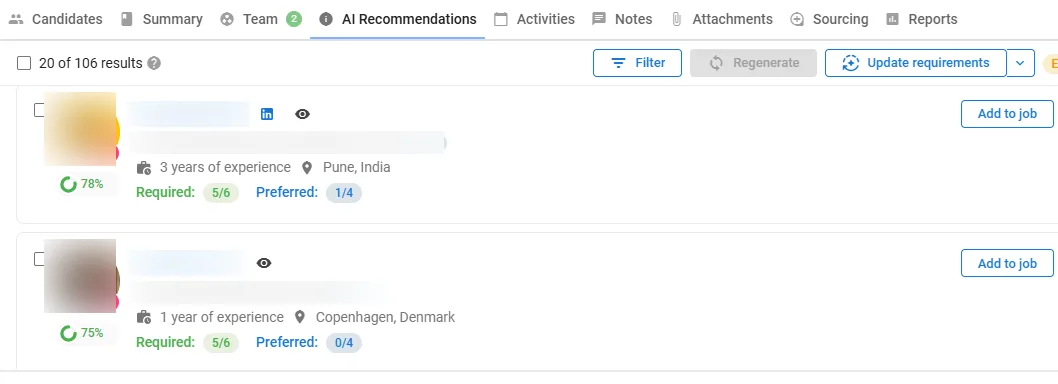
On a real test search for a junior full-stack role, Manatal’s AI returned 106 ranked matches and scored each one against the job. The top two came back at 78% and 75%, each with a transparent breakdown (required skills 5/6, preferred 1/4), which makes triaging a long shortlist quick. The ranking is only as good as the job description you feed it, but as a first pass it does real work.
The Manatal applicant tracking system, day to day
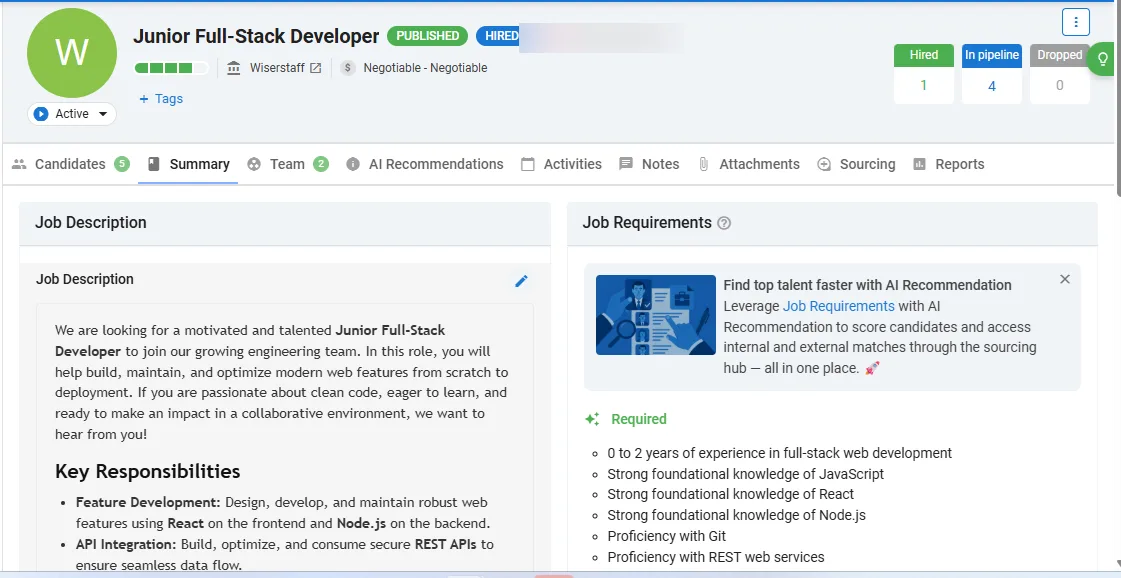
Under the AI layer, the Manatal applicant tracking system is a conventional pipeline, and that is meant as a compliment: nothing about the core recruitment process needs relearning. On my test role the sequence was the standard one. I created the job, let the parser turn incoming CVs into structured candidate records, and moved candidates through the stages to a hired outcome, with each candidate’s match score sitting alongside their name the whole way. The workspace screenshot further down shows where that run ended: one hired, four still in the pipeline.
Two details made the daily workflow quicker than I expected. Because the AI scores live inside the pipeline rather than in a separate report, triage happens where the work happens; I never had to leave the candidate list to decide who moved forward. And the job, the candidates and (on the agency side) the client record sit one click apart, so logging a placement after a hire was a few clicks, not a context switch. None of this is flashy, which is rather the point: the tracking layer stays out of the way so the sourcing layer can earn the subscription.
Manatal plans and what each tier unlocks
Manatal’s tiers gate automation and API access behind the upper plans, so the plan you need depends less on team size than on whether you automate. It sells per-user, per-month tiers (Professional, Enterprise, Enterprise Plus, plus an on-demand Custom plan), and the jump between them is mostly about what each unlocks, not seat count. The entry Professional plan handles core tracking but caps open jobs and the candidate database, and it keeps status changes and follow-ups manual. Workflow automation arrives on Enterprise; SSO and the API sit on Enterprise Plus only. Reading the tiers this way matters most for agencies that automate at volume; for those, the agency-focused ATS shortlists put Manatal next to its closest rivals.
| Capability | Professional | Enterprise | Enterprise Plus |
|---|---|---|---|
| Core ATS & pipeline tracking | Yes | Yes | Yes |
| AI sourcing & recommendations | Yes | Yes | Yes |
| Recruitment CRM | Yes | Yes | Yes |
| Open jobs / candidates | 15 / 10,000 | Unlimited | Unlimited |
| Workflow automation | No | Yes | Yes |
| SSO | No | No | Yes |
| API / Zapier integration | No | No | Yes |
| Price (per user / month) | $19 ($15 annual) | $39 ($35 annual) | $59 ($55 annual) |
Prices are the in-app subscription figures, captured June 2026. Annual billing saves most on the entry tier: about 21% on Professional ($19 to $15), and roughly 7–10% on Enterprise and Enterprise Plus ($39 to $35, $59 to $55). There is a 14-day free trial with no credit card, and no free plan after it: you pick a paid tier or stop. The Custom plan is quote-only and adds a dedicated account manager and custom integrations.
What Manatal pricing means for a real team
Manatal pricing is per user, so the bill scales with the size of your desk rather than your candidate volume, at least until the entry plan’s caps bite. The headline $15 is the number to ignore; the number to weigh is your real monthly bill at your actual seat count, on the tier you’ll actually run. Worked through on annual billing:
| Seats | Professional ($15/user) | Enterprise Plus ($55/user) |
|---|---|---|
| 3 | $45/mo | $165/mo |
| 10 | $150/mo | $550/mo |
| 25 | $375/mo | $1,375/mo |
The gap between the two columns is the price of automation (the API and Zapier unlock only on Enterprise Plus), and it widens with every seat: $120/mo at three seats, $1,000/mo at twenty-five. A solo recruiter will take far longer to hit the Professional caps (15 open jobs, 10,000 candidates) than a busy agency desk will, which is why the same entry plan can be a bargain for one buyer and a false economy for another.
Integrations and automation
What you can automate with Manatal is real but paywalled: an official Zapier app and a REST API drive it, and both sit on the top plan only. On the plans below that, the tool runs manually. (If the line between the ATS itself and the automation layer on top feels blurry, the ATS vs recruitment automation entry draws it in a paragraph.)
When the API is unlocked, the surface is solid. Manatal publishes an official Zapier app with seven real-time triggers (a new candidate, a candidate moved to a new pipeline stage, a job-status change, and others), plus dozens of create-and-update actions, so a non-developer can wire onboarding or notifications without code. Underneath, native webhooks fire on the same candidate, match (pipeline) and job events, and a REST API gives full create/read/update/delete access to candidates, jobs, applications, contacts and client organisations. That is enough to sync Manatal with a payroll tool, a Slack channel or a spreadsheet.
The limits are worth knowing before you build. Access is gated to the top tier, so a small team on an entry plan cannot automate through the API at all. The API is rate-limited to 100 requests per minute per token and has no bulk endpoint, which slows a large candidate migration. And the docs don’t publish a webhook signing secret, so confirming a webhook genuinely came from Manatal takes extra care. These details come from Manatal’s own developer documentation; the per-plan price to unlock them is in the table above.
Where Manatal falls short
Manatal is built for SMBs and agencies, not enterprises, so its depth has clear edges. AI parsing and recommendations are tuned for English-language CVs; I tested it on an English-language role, so I can’t vouch for its accuracy on other languages, which is worth checking yourself if you hire multilingually. As covered above, automation and API access are gated to the upper plans, so a small team that automates pays up to do it. And for a high-volume staffing desk, a dedicated agency CRM (Bullhorn, Recruit CRM, JobAdder) manages clients and placements more deeply; treat Manatal as the affordable end of the market rather than a like-for-like replacement. If you’re weighing that trade from the other side, the Bullhorn alternatives round-up runs the cost maths desk by desk.
The limitation I hit in real use is posting reach. Manatal doesn’t push a job out to the big third-party boards (LinkedIn, Indeed) automatically. The workaround is manual: you post the role yourself on each platform, then add the collection email Manatal gives you so applications flow back into the dashboard. It works, but it isn’t the one-click multi-posting some pricier tools sell.
Who shouldn’t buy Manatal
Skip Manatal if you run a high-volume temp or contract staffing desk: its CRM covers clients and placements, but a dedicated agency system (Bullhorn, Recruit CRM) handles pay-and-bill, back-office and timesheets that Manatal doesn’t. Skip it too if AI scoring isn’t the point for you and you mainly want the simplest possible pipeline: a flat-priced visual tool like Breezy HR will feel lighter and cost less per seat. And skip the entry plan specifically if day-one automation is non-negotiable, because the API is two tiers up. The buyer Manatal fits is the small in-house team or boutique agency that wants AI sourcing at an SMB price and can run the first months manually.
What happens if you leave Manatal
Two things make Manatal easier to leave than an enterprise ATS, and one caveat is worth checking before you commit. In its favour: it bills per user, month to month or annually with a 14-day trial, so there’s no multi-year contract to buy your way out of the way there is with Bullhorn — the shortest exit is a billing cycle, not a renewal window. And because Manatal ships GDPR, CCPA and PDPA tooling on every tier, candidate-data export and deletion are first-class features rather than a support ticket.
The caveat: I have not run a full account export myself, so I can’t yet vouch first-hand for whether it carries everything out cleanly — structured candidate fields usually export fine, but notes, stage history and CRM client records are the fields that don’t always map to the next system. Before you migrate, run a test export of one job and its candidates and confirm the notes and history came with them. When I test the export directly, I’ll report exactly what transferred.
What users say about Manatal
On Capterra, Manatal holds 4.6 out of 5 across 141 reviews (ease of use 4.7, customer service 4.6, checked July 2026, Capterra). The praise and the gripes line up closely with what I found hands-on.
- Agencies rate the AI candidate recommendations and the one-tool CRM highest. Recruiters describe the recommendations as a genuine time-saver and value keeping clients, candidates and placements in one system instead of a separate CRM.
- Small in-house teams keep coming back to the price. The recurring line is that little else scores candidates for you at this cost.
- The recurring complaint is depth rather than usability. Reviewers flag thin recruitment reporting and metrics, and note the bill climbs as you add features or seats, the same automation-and-API ceiling I hit on the entry plan.
Those scores blend agency and in-house voices, and the two want different things from the tool: the recruitment CRM is central for an agency and a bonus for an in-house team.
How I tested Manatal
I review an ATS with the WiserStaff 5-Signal Test: running a real workflow through it (creating a job, sourcing and parsing candidates, moving them through stages, and — for the CRM side — logging a client against a placement) and scoring five signals out of two points each. I pay with my own account, and the affiliate link on this page never changes the verdict. Our testing method in full states what a score covers and what it deliberately leaves out.
For this review I created a real job (a junior full-stack developer role), ran Manatal’s AI sourcing on it (the 106-match search above), built a pipeline, and moved candidates through to a hired stage, logging two placements on the CRM side. Tested on the free trial in June 2026.
Manatal review FAQ
Does Manatal have a free plan? No. Manatal offers a 14-day free trial with no credit card, but there is no free plan once it ends; you move to a paid tier or stop.
Which Manatal plan includes API access and automation? Workflow automation starts on Enterprise; SSO and the API/Zapier integration are gated to Enterprise Plus, the top tier. The entry Professional plan is manual-only for status changes and follow-ups.
How much does Manatal cost? From $19 per user per month on Professional (or $15 billed annually), $39 on Enterprise, and $59 on Enterprise Plus; a Custom plan is quote-only. Prices captured in-app in June 2026.
Is Manatal good for agencies? Yes, because of the built-in recruitment CRM that tracks clients and placements alongside candidates. High-volume desks may still prefer a dedicated agency CRM; the agency round-up sets out when each makes sense.
The verdict: 9/10
The WiserStaff 5-Signal Test scores five signals, each out of two points: sourcing power, ease of use, value for the tested price, fit and integrations, and setup and support. Manatal takes full marks on four signals and one out of two on integrations, for 9/10.
The AI sourcing is genuinely good: it ranked a real candidate list in seconds and showed its working (the 78%/75% breakdowns above), and the price is right for a small team. It loses that integrations point for one reason: the automation that matters (the API, Zapier and webhooks) is locked to the top tier, so on the free trial and the entry Professional plan there is none of it, and even then Manatal won’t post to LinkedIn or Indeed for you. The basics (Gmail and Outlook sync, the Chrome sourcing extension, an email-collection inbox) are there; the automation layer that would let a small team wire it into a stack is not, unless you pay up. If automation is core to how you work, budget for Enterprise Plus or look elsewhere. If you want strong AI sourcing and tracking at an SMB price, Manatal earns its place.
Choose Manatal if you want AI sourcing, candidate tracking and a client CRM in one affordable tool, and you can live with automation on the upper plans. → See Manatal
For where applicant tracking fits in the bigger picture, see which HR tasks you can hand to software.