Round-up
Best AI HR tools in 2026: tested picks and what AI really costs
The best AI HR tool for most small teams is Manatal: tested AI candidate scoring at $19 per user per month. Breezy HR adds an optional AI-match add-on to a tested pipeline ATS. Most 'AI HR tools' are features inside software you already need, so buy the tool first and the AI second.
The best AI HR tools for small teams
The best AI HR tool for most small teams is Manatal, because its AI candidate scoring is included in a $19-per-user plan (see plans) rather than sold back as an upsell, and it’s the one AI feature I’ve tested that changed the work: 106 scored candidates for one role, with the scoring visible. Breezy HR is the pick if you’d rather buy a tested pipeline ATS first and treat AI as an option. Beyond those two, this market runs on lists of 47 tools nobody has actually used, so this page does something different: it splits what’s tested from what isn’t, and explains the three AI pricing models (the 3-Model AI-Pricing Test) before you meet them in a sales call.
Job seeker wondering how AI reads your CV before a human does? This page is for employers choosing tools; the screening mechanics are in the glossary entry on what an ATS is.
What counts as an AI HR tool in 2026
An AI HR tool is HR software that runs machine learning on messy inputs: candidate CVs, job descriptions, employee questions, engagement comments. That’s the honest definition, and it immediately sorts the market into three buckets:
- AI features inside core HR software. Candidate scoring in an ATS, anomaly flags in payroll, drafted replies in a helpdesk. You buy the tool, the AI comes with it (or as an add-on). This is where almost all SMB value sits, and it is what most people mean when they shop for AI HR software or for AI powered applicant tracking systems: not a new category, but intelligence added to the tool you were buying anyway.
- Standalone HR AI products. Chatbot assistants (Leena AI), interview agents (Paradox), sourcing engines (Eightfold). Built for volume problems: thousands of applications, thousands of employee tickets.
- General AI. ChatGPT and its peers, used for drafting. Free or cheap, useful, and covered honestly below.
For the wider view of where these tools sit, from job-description drafting down to the payroll layer underneath, see the AI hiring stack, layer by layer.
One distinction from the HR automation map carries over here: classic automation is rules-based and does what you told it, while AI features are probabilistic and can be confidently wrong. That’s precisely why a person signs off anything AI suggests about a human being.
How I chose these
I only score tools I’ve tested with my own account, so this list splits in two. Manatal and Breezy HR carry tested verdicts from real hiring runs, documented in how WiserStaff tests tools. Workable, Lattice and Leena AI are credible names I haven’t run, listed with documented facts and no scores. Affiliate links are disclosed above this content and never change a ranking; none of the untested tools carries an affiliate relationship.
The tested picks
Manatal: AI scoring and sourcing, included rather than upsold
Manatal pairs an applicant tracking system with AI candidate recommendations scored against each job, plus a recruitment CRM, at a price where the AI isn’t a premium tier. That pricing shape is the story: most vendors gate their intelligence behind the expensive plan; Manatal’s scoring ships from the Professional tier.
Tested (Jul 2026): 9/10. From $19/user/mo ($15 billed annually) on Professional. The AI search returned 106 scored matches for my test role, with match percentages broken down by required and preferred skills rather than a black-box number. Automation and the API sit on upper plans. Full detail in the Manatal review. → See Manatal
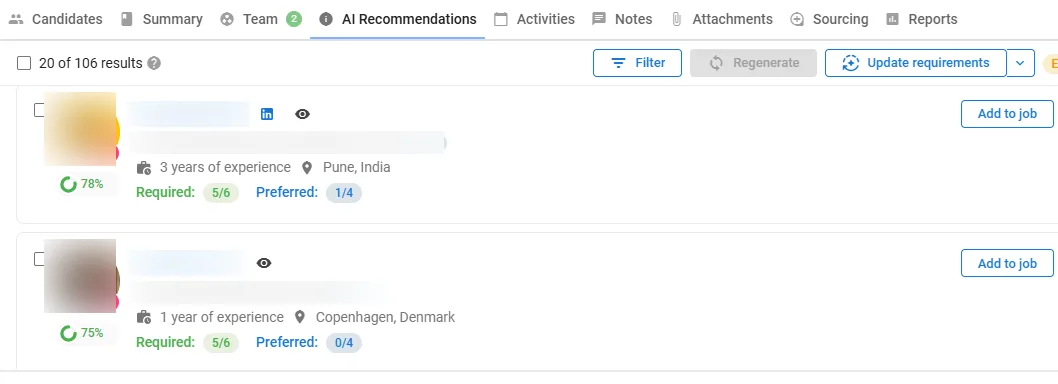
The visible scoring matters for the compliance section below: when a person reviews why the AI ranked someone, you can defend the process. When they can’t, you’re trusting a black box with a hiring decision.
Breezy HR: the tested ATS where AI is optional
Breezy earns its place here by being honest about what it is: a visual pipeline ATS a non-recruiter can run, with AI candidate matching sold as an add-on rather than baked into the price. If your hiring is occasional, that’s the right shape. You pay for the pipeline you use daily, not for intelligence you’d use twice a quarter.
Tested (Jul 2026): 9/10. Free Bootstrap plan for one active position; the Startup tier is $189/mo flat ($157 billed annually) with unlimited positions. The AI scoring and the API cost extra, and I haven’t paid for the add-on, so my score reflects the core product. Full detail in the Breezy HR review. → See Breezy HR
That unpaid add-on is worth dwelling on, because it’s the honest version of a pattern you’ll meet everywhere: a strong core tool with “AI” attached at a price. The deciding question: what does the AI cost, and how often would you use it? Which brings us to the part the 47-tool lists skip.
What AI really costs inside HR tools: the 3-Model AI-Pricing Test
Nobody ranking for this search explains AI pricing models, and they decide more than features do. Before you shortlist any tool, run it through the 3-Model AI-Pricing Test — work out which of these three patterns its AI uses, because that decides your real bill more than the feature list does:
| Pricing model | How it works | Example (dated) | Right for |
|---|---|---|---|
| Included | AI ships in the base plan | Manatal AI scoring from $19/user/mo (tested Jul 2026) | Occasional and continuous use alike |
| Add-on | Flat fee on top of the plan | Breezy HR AI matching, extra over the $189/mo flat plan (add-on untested, figure pending) | Frequent use of one specific feature |
| Credits | Metered units, prepaid | Workable: 3,000 AI credits included, top-ups from $600 for 5,000, credits expire after one year (workable.com pricing, checked Jul 2026) | High, steady hiring volume |
The credits row deserves the caution. Metered AI suits a team that spends credits every month; for a team that hires in bursts, prepaid credits with a 12-month expiry are the wrong shape, the same way headcount-priced plans are. If a vendor can’t tell you what a month of your actual usage costs, treat the AI as undecided until they can.
Still on my list to test
Documented facts only, no scores and no invented prices.
Workable
Workable has pushed hardest among SMB ATSs into agent-style AI (screening assistance, sourcing, drafted outreach), running on the credit system above. The platform itself is capable and posts roles to a large number of job boards at once; the open question for a small team is whether the credit economics fit burst hiring. The full cost picture, including the headcount-based plan pricing, is in the Workable pricing breakdown.
Lattice
The best-known name for AI in performance and engagement, positioned around review summaries, engagement-comment analysis and manager prompts. It assumes a running performance process and someone to own it, which is why it fits mid-market teams better than a ten-person company still doing reviews over coffee. I haven’t tested it, so no price and no score appear here.
Leena AI
The reference name in HR assistant chatbots: an internal agent that answers “how many days off do I have left?” so a person doesn’t have to. The economics only work once repetitive HR questions arrive at volume, which is an enterprise problem. A small team’s version of this is a good FAQ page and a payroll tool with decent self-service.
Where ChatGPT fits (and where it must not)
The live Reddit thread ranking for this exact search asks “apart from ChatGPT, what are some good AI tools for HR?”, which tells you what practitioners already know: general AI quietly does a lot of small-team HR work. Reasonably so. Job-description drafts, policy first drafts, interview question banks and difficult-email rewrites are real time savings, and they cost nothing.
Two hard limits keep it safe. Never paste employee or candidate personal data into a general chatbot: it isn’t a data processor you have terms with, and a privacy slip in HR is not a recoverable mistake. And never let it make a people decision: general models are confidently wrong exactly where HR stakes are personal. Draft with it, decide without it.
The compliance line
The rule from the HR automation map applies double to AI features. New York City’s Local Law 144 requires a bias audit of automated hiring tools, the EEOC holds US employers responsible for discriminatory outcomes even when software made the call, and UK/EU GDPR restricts fully-automated decisions about people. In practice: let AI sort, score and suggest; keep a person on every advance-or-reject call; and ask any vendor for their bias-audit position before you switch the feature on. Tools with visible scoring, like the tested pick above, make that conversation considerably easier.
At a glance: AI HR tools compared
Prices are the real, dated figures from tools I’ve reviewed; untested tools show documented facts only.
| Tool | AI does what | AI pricing model | Tested price | My status |
|---|---|---|---|---|
| Manatal | Candidate scoring + sourcing | Included | $19/user/mo ($15 annual) | Tested 9/10 |
| Breezy HR | Candidate matching | Add-on (extra) | $189/mo flat, core ($157 annual) | Tested 9/10 (core) |
| Workable | Screening + sourcing agents | Credits ($600/5,000 top-up) | not tested | Not yet tested |
| Lattice | Performance & engagement analysis | Not verified | not tested | Not yet tested |
| Leena AI | Employee-question assistant | Not verified | not tested | Not yet tested |
| ChatGPT (general) | Drafting only | Free–$20/mo | — | Use with the two limits above |
Which AI HR tool should you choose?
Buy the tool first and the AI second. If hiring is the job, Manatal gives you tested AI scoring included at SMB pricing, and Breezy HR gives you a tested pipeline with AI as a decision you can defer. If you’re being pitched credits or platform quotes, price a month of your real usage before signing anything. And whatever you run, keep a person on every decision about a person: it’s the law in a growing list of places, and it’s also just better hiring.
Where each of these sits in a wider automated stack, human gates included, is mapped in what HR processes you can automate; if the AI you actually need is applicant tracking, start from the best ATS software round-up.
FAQ
What are AI HR tools?
AI HR tools are HR software features or products that use machine learning on messy inputs: scoring candidates against a job, parsing CVs, drafting job descriptions or answering employee questions. In 2026 most of them are features inside a core tool you already need, such as an ATS or HRIS, rather than standalone purchases. The practical split is three buckets: AI built into core HR software, standalone HR assistants, and general models like ChatGPT used for drafting.
What is the best AI tool for HR?
For a small team, Manatal: its AI candidate scoring is included from $19 per user per month, and in my hands-on test it returned 106 scored matches for one role with the scoring visible. If you want a tested ATS and would rather treat AI as an optional extra, Breezy HR. Enterprise lists lead with Eightfold or Paradox, but those solve volume problems small teams don't have.
How much do AI HR tools cost?
It depends on the pricing model, which matters more than the sticker. Three patterns cover 2026: included (Manatal bundles AI scoring from $19/user/mo), paid add-on (Breezy HR sells AI matching on top of its $189/mo flat plan), and credits (Workable includes 3,000 AI credits, then top-ups start at $600 for 5,000, expiring after a year, per its published pricing checked July 2026). For occasional use, included beats credits.
Can AI replace HR?
No. AI in HR handles the probabilistic admin: reading CVs, ranking candidates, drafting text and answering routine questions. The decisions that define HR (who to hire, how someone is performing, anything sensitive) stay with people, both because judgement is the job and because regulators hold employers responsible for automated decisions. Treat AI output as a suggestion a person signs off, not a decision it makes alone.
What are AI powered applicant tracking systems?
An AI powered applicant tracking system is a normal ATS with machine learning added to the parts that scale badly: parsing CVs, matching applicants to a job's requirements, ranking a shortlist and drafting outreach. The scoring is a suggestion, not a decision. Of the two I have tested, Manatal includes AI scoring from its $19-per-user plan (106 scored matches on my test role, with the breakdown visible), while Breezy HR sells AI matching as an add-on above its $189-a-month flat plan. Ask for visible reasoning: a score you cannot explain is one you cannot defend.
What are the best HR chatbots?
HR chatbots split into two kinds, and the honest answer for a small team is that only one of them is worth buying. Employee-facing assistants such as Leena AI sit on your policies and answer the same questions over and over, 'how many days off do I have left?', which only pays for itself once those questions arrive at volume: that is an enterprise problem. Candidate-facing chatbots such as Paradox screen and schedule at high applicant volumes. Below both, a small team's version is a good FAQ page plus a payroll tool with real self-service, and it costs nothing extra. I have not run either product on a paid account, so neither carries a score here.
Is it legal to use AI in hiring?
Broadly yes, with real conditions. New York City's Local Law 144 requires a bias audit of automated hiring tools, the EEOC holds US employers responsible for discriminatory outcomes even when a tool made the call, and UK/EU GDPR restricts fully-automated decisions. The safe pattern is the one that also produces better hires: AI sorts and suggests, a person makes the advance-or-reject call, and you check a vendor's bias-audit position before switching it on.
Is ChatGPT good enough for HR work?
For drafting, yes: job descriptions, policy first drafts, interview question banks and awkward-email rewrites are where general AI genuinely saves HR time. Two hard limits: never paste employee or candidate personal data into a general chatbot, and never let it make people decisions, because it's confidently wrong precisely when the stakes are personal. Anything touching records, screening or pay belongs in purpose-built tools with data-processing terms.