Round-up
Best Bullhorn alternatives (2026): tested picks for small desks
The best Bullhorn alternative for a small staffing desk is Manatal: AI sourcing plus a client CRM at $19/user/month, tested 9/10. Breezy HR suits desks that mainly need a fast pipeline. Bullhorn publishes prices of $99 to $165 per user per month, but implementation fees and contract terms are what push small agencies out.
The best Bullhorn alternatives for a small desk
The best Bullhorn alternative for most small staffing and recruiting desks is Manatal: it covers both halves of agency work, candidates and clients, at $19 per user per month (see plans), and it’s the pick I’ve tested hands-on (9/10). Breezy HR is the simpler route if your desk mainly needs a fast visual pipeline and only light client tracking. Bullhorn remains the default at enterprise scale; the reasons small agencies leave are the per-seat bill, the implementation project and the contract that comes with both.
Almost every page ranking for this search is an ATS vendor nominating itself. I don’t sell an ATS. This round-up leads with the two tools I’ve tested with my own account, then names four credible agency-built candidates I haven’t, with no invented scores and no invented prices.
Job seeker trying to get past an ATS? This page is for the agencies running one. What these systems do with your CV is covered in the glossary entry on what an ATS is.
What Bullhorn is, and why desks look elsewhere
Bullhorn is an applicant tracking system and recruitment CRM built for staffing and recruiting agencies: candidates and jobs on one side, client companies, contacts and placements on the other, with middle- and back-office modules for temp desks layered on top. For a large agency running high-volume placements, it earns its position as the industry incumbent, and nothing on this page argues otherwise.
The buyer it fits less well is the desk this page is for: one to fifteen recruiters, perm or light contract work, no operations team to run the software. Three patterns push those desks here:
- The per-seat bill. Bullhorn now publishes entry pricing: $99 per user per month for Starter and $165 for Core (bullhorn.com/pricing, checked July 2026). A three-recruiter desk on Starter is $3,564 a year before anything else; on Core it’s $5,940.
- The start-up project. The licence isn’t the whole cost. Pin’s Bullhorn pricing teardown reports implementation fees of $1,000–$5,000 for agencies of one to ten users, with training charged separately at $100 to $500 per user. You’re funding a rollout, not downloading an app.
- The contract, not the product. The same teardown reports that a seat added mid-term is paid through the end of the contract whether that recruiter stays or not, that Bullhorn pushes for multi-year terms, and that Capterra reviewers report renewal increases of around 20%. None of this makes Bullhorn a bad product. It makes it a procurement decision, and a small desk rarely has a procurement department.
Cost isn’t the only push. The Daily Hire’s Bullhorn review, summarising G2 feedback, describes the interface as dated and clunky next to modern software; on a desk where recruiters live in the tool all day, that friction compounds.
What Bullhorn actually costs in 2026
Bullhorn ATS pricing, in short: $99 per user a month on Starter, $165 on Core, both published July 2026, with the Pro tier quote-only. Implementation, training and renewal increases sit on top.
Credit where it’s due: Bullhorn publishes its two entry prices, while several of the teardowns ranking for this search still describe its pricing as quote-only. What the published number leaves out is the rest of the invoice. Everything below is either from Bullhorn’s own pricing page or attributed to Pin’s reporting; I have not run a Bullhorn account myself.
| Item | Figure | Source |
|---|---|---|
| Starter plan | $99/user/mo | Bullhorn pricing page, Jul 2026 |
| Core plan | $165/user/mo | Bullhorn pricing page, Jul 2026 |
| Pro plan | Quote-only | Bullhorn pricing page, Jul 2026 |
| Implementation (1–10 users) | $1,000–$5,000 (reported) | Pin pricing teardown |
| Training | $100–$500 per user (reported) | Pin pricing teardown |
| Renewal | ~20% increase attempts (reported) | Capterra reviewers, via Pin |
Run the maths for a three-recruiter desk on Starter: $3,564 a year in licences, plus a reported $1,000–$5,000 to get running, plus training. Year one lands somewhere between $5,000 and $9,000 before a single add-on module. The same desk on Manatal’s Professional plan at the annual rate is about $540 a year. That gap, not any feature checklist, is why this page exists.
Who should stay on Bullhorn
If you run a high-volume temp or contract desk, bill through Bullhorn’s middle- and back-office, feed VMS portals, or coordinate twenty-plus recruiters on shared accounts, Bullhorn’s depth is exactly what you’re paying for, and the SMB tools below would feel like a downgrade. The implementation cost spreads over enough seats and placements to be rational.
That warning extends to the picks below. Neither Manatal nor Breezy includes temp back-office — timesheets, shift management, pay-and-bill — so a desk that bills contractors through its software has no straight swap on this page: Zoho Recruit’s staffing edition is the closest SMB candidate, and its contract workflows need verifying against your model before any move. This page is for the perm and light-contract desk: the one paying enterprise-infrastructure prices to move candidates through stages and keep a client list warm.
How I chose these
I only score tools I’ve run with my own account, so this list splits in two. Manatal and Breezy HR carry tested verdicts from their own hands-on reviews; the process is documented in how WiserStaff tests tools. Zoho Recruit, Recruit CRM, Crelate and Loxo are credible agency candidates I haven’t run, so they appear with no scores and no third-hand prices. Affiliate links are disclosed above this content and never change a ranking; the four untested tools carry no affiliate relationship at all.
Pick by what your desk actually needs
Sourcing plus a client CRM → Manatal
For a small desk leaving Bullhorn, the question is what you keep: Manatal keeps the agency shape. It pairs candidate tracking with AI sourcing and a client CRM, so placements, client contacts and pipelines live in one tool rather than in an in-house ATS with a spreadsheet bolted on. In my test the AI search returned 106 ranked matches for one role, with the match scoring visible rather than black-box.
Tested (Jul 2026): 9/10. From $19/user/mo ($15 billed annually) on Professional. The client and placement layer is built in, not an add-on. Automation and the API sit on upper plans, and it won’t post to LinkedIn or Indeed for you. Full detail in the Manatal review. → See Manatal
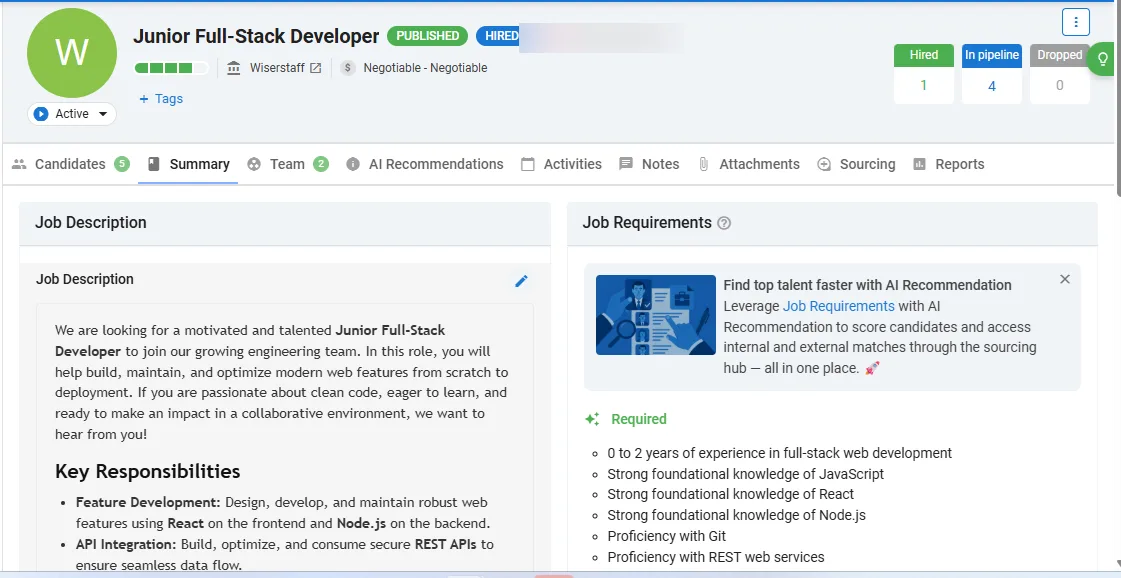
This is my real Manatal workspace from that test, the pipeline view a desk lives in day to day:
One honest caution from the buyer side: a solo recruiter comparing platforms put it bluntly on Reddit — “Manatal is streamlined, but it gets so pricey! Every time you add a feature, the price gets unrealistically high.” The $19 base is real, and so is the add-on ladder above it. Price the plan you’ll actually run, not the one on the banner.
A pipeline anyone can run → Breezy HR
Breezy is the pick if your desk’s real workload is moving candidates through stages fast, and client management can stay light. Fair warning, stated plainly because it matters for an agency: Breezy is an in-house-first ATS, so client and placement tracking is thinner than Manatal’s built-in CRM. What you get in exchange is the easiest pipeline in this list and flat pricing that ignores seat count entirely. If client submittals and placement billing are core to your day, skip Breezy and stay on the agency-built side of this list.
Tested (Jul 2026): 9/10. The free Bootstrap plan runs one active position with unlimited users. The Startup tier is $189/mo flat ($157 billed annually) with unlimited positions and unlimited users. For a five-recruiter desk, flat beats Bullhorn’s per-seat model by design: the bill doesn’t grow when the team does. Full detail in the Breezy HR review. → See Breezy HR
If you’re weighing more agency options beyond a Bullhorn exit, the ranked shortlist of agency ATS picks covers the wider field; teams hiring for their own company rather than placing candidates should use the in-house ATS round-up instead.
At a glance: Bullhorn alternatives compared
Prices are the real, dated figures from the tools I’ve reviewed; untested tools show no price and no score on purpose.
| Tool | Agency CRM? | Pricing model | Free tier / trial | Tested price | My status |
|---|---|---|---|---|---|
| Manatal | Yes (built-in) | Per user | Trial | $19/user/mo ($15 annual) | Tested 9/10 |
| Breezy HR | In-house first | Flat, by active positions | Free plan | $189/mo flat ($157 annual) | Tested 9/10 |
| Zoho Recruit | Yes (staffing edition) | Per user | Free tier | not tested | Not yet tested |
| Recruit CRM | Yes (agency-native) | Per user | Trial | not tested | Not yet tested |
| Crelate | Yes (agency-native) | Per user | Trial | not tested | Not yet tested |
| Loxo | Yes (agency-native) | Per user | Trial | not tested | Not yet tested |
| Bullhorn (baseline) | Yes (built-in) | Per user, contract term | No | $99–$165/user/mo published (Jul 2026) | Baseline |
Still on my list to test
The Bullhorn competitors that come up most often for small desks are the four below: credible agency-built candidates I haven’t run myself, so no scores and no unverified prices.
Zoho Recruit
The budget route with real agency credentials: a dedicated staffing-agency edition built around clients and placements, plus a genuine free tier for a single recruiter. Strongest if you already live inside the Zoho suite, and the free tier makes it the cheapest way to test whether an SMB tool can carry your desk at all. The Bullhorn-or-Zoho question, with both price lists captured at source, is answered on the Zoho Recruit alternatives page, which works this market from the Zoho side.
Recruit CRM
Purpose-built for recruitment agencies, with candidates, clients and placements as first-class objects rather than retrofits. It shows up consistently in the shortlists small desks actually discuss, usually as the “built for us, priced for us” option against Bullhorn’s enterprise frame.
Crelate
An agency ATS/CRM with a strong following among executive-search and perm firms, where long client relationships matter more than raw requisition volume. If your desk is search rather than staffing, it belongs on the trial list.
Loxo
The sourcing-first option: Loxo wraps an ATS/CRM around a large talent database and outreach tooling. If your bottleneck is finding candidates rather than tracking them, its pitch is aimed squarely at you.
How to leave Bullhorn without losing your data
The expensive mistake is timing the product decision without timing the contract. Four steps, in order:
- Read your contract before you trial anything. Check the end date, the renewal-notice window and what happens to mid-term seats. Pin reports that added seats are paid through the end of the term, so the cheapest exit date is written in the paperwork, not the product. While you’re there, ask Bullhorn support what a full data export includes and whether extraction costs extra, so the answer arrives before your notice window closes.
- Export while access is live. Candidates, client companies, contacts, placements, notes and activity history. The Daily Hire’s review reports that agencies migrating after years on Bullhorn often lose data fidelity or historical context in the move, so export early and check what actually came out.
- Verify a sample desk-load in the new tool. Import one client, its placements and fifty candidates into your trial account. If notes or custom fields didn’t survive, you’ve found out on fifty records instead of fifty thousand.
- Run one placement cycle in parallel. Keep Bullhorn read-only through a full cycle on the new system, then compare. The Freshteam shutdown guide walks the same parallel-run playbook for teams migrating under a harder deadline.
Which Bullhorn alternative should you choose?
Decide on the shape of your desk, then on the tool. If clients and placements are half your day, Manatal keeps the agency structure at about a seventh of Bullhorn’s published Starter cost (and under a tenth of Core), and it’s the tested pick. If your work is nearly all candidate pipeline, Breezy HR’s flat $189 a month stops the per-seat meter entirely, as long as you accept its in-house-first shape. And if the budget answer must be zero, start with Zoho Recruit’s free tier and prove the desk fits before paying anyone. Whichever you pick, read the Bullhorn contract first, and export your data while the login still works.
For where an agency’s tracking and sourcing stack fits among the hiring and HR processes worth automating, the pillar guide maps the whole field.
FAQ
How much does Bullhorn cost in 2026?
Bullhorn publishes two entry prices on its pricing page, checked July 2026: Starter at $99 per user per month and Core at $165 per user per month, with the Pro tier quote-only. The published price is not the whole bill. Pin's pricing teardown reports implementation fees of $1,000 to $5,000 for small agencies and separate training at $100 to $500 per user, and Capterra reviewers report renewal increases of around 20%.
Is Bullhorn a CRM or an ATS?
Both. Bullhorn combines an applicant tracking system with a recruitment CRM: candidates and jobs on one side, client companies, contacts and placements on the other, plus middle- and back-office modules for temp and contract desks. That dual structure is why staffing agencies default to it, and it is the standard any alternative has to match on the client side.
What is the cheapest Bullhorn alternative?
Zoho Recruit's free tier is the cheapest genuine starting point for an agency, and its staffing edition is built for client and placement work. Among the tools I've tested hands-on, Manatal starts at $19 per user per month ($15 billed annually), which for a three-recruiter desk is roughly $540 a year against about $3,564 on Bullhorn's published Starter price.
Is there a Bullhorn alternative for UK agencies?
The candidate side travels. These are cloud ATS products a UK desk runs the same way a US one does, and the thing worth checking first is job-board coverage against the boards you actually post to. What doesn't travel is the money side: none of these picks runs UK pay-and-bill or payroll, so a contract desk placing temps in the UK has to handle timesheets, umbrella arrangements and off-payroll status somewhere else. For a UK temp desk that requirement usually decides the shortlist before any ATS feature does. I test from outside the UK and have not run a UK payroll integration myself, so treat this as scoping, not a verdict.
Can I get my data out of Bullhorn?
Yes, but plan for it. Bullhorn supports data exports, and The Daily Hire reports that agencies switching after years of accumulated data often lose fidelity or historical context in the move, because notes, custom fields and activity history don't always map cleanly to the new system. Export candidates, clients, placements and notes while your access is live, and verify a sample record in the new tool before the old contract ends.