Round-up
Best ATS for staffing agencies & recruiting firms (2026)
For most small recruiting and staffing agencies, Manatal is the best all-round ATS in 2026: it pairs AI candidate sourcing with an agency-style CRM at an SMB price. Choose Zoho Recruit for a dedicated staffing-agency edition on a tight budget, or Breezy HR if a fast visual pipeline matters more than agency CRM features.
The best ATS for staffing agencies, ranked
The best ATS for staffing and recruiting agencies in 2026 is Manatal for most small desks: it pairs AI candidate sourcing with an agency-style CRM at a price a small team can actually afford (see plans). Zoho Recruit is the budget pick, with a dedicated staffing-agency edition and a free tier, and Breezy HR wins if a fast, visual pipeline matters more to you than agency CRM features. Manatal and Breezy were each run on a real role before being ranked here; Zoho Recruit is researched from its published pricing, not tested. The full table is below, then a hands-on take on each.
Your ATS tracks candidates, but who tracks your clients? That question splits an agency tool from an in-house one, and it’s the point the vendor-written lists ranking for this search skip. I don’t sell an ATS: I test them with my own accounts and lead with the two I’ve run to a hire.
Job seeker who hit an agency’s ATS? This page is for the recruiters running one, not the candidates going through it. What these systems do with your CV is covered in the glossary entry on what an ATS is.
This round-up is scoped to small and growing agencies (roughly 1 to 15 recruiters), not enterprise staffing desks. If you run high-volume placement at scale, a dedicated recruitment CRM (Bullhorn, Recruit CRM, JobAdder) is worth shortlisting alongside these; see the last FAQ for why. And if you’re moving the other way, off Bullhorn rather than up to it, the Bullhorn alternatives for small desks ranks the affordable exits with Bullhorn’s real published pricing as the baseline.
Hiring for your own company rather than placing candidates for clients? This page is for agency desks. If you staff your own roles in-house, the shortlist is different, so read our guide to the best ATS software for in-house teams instead.
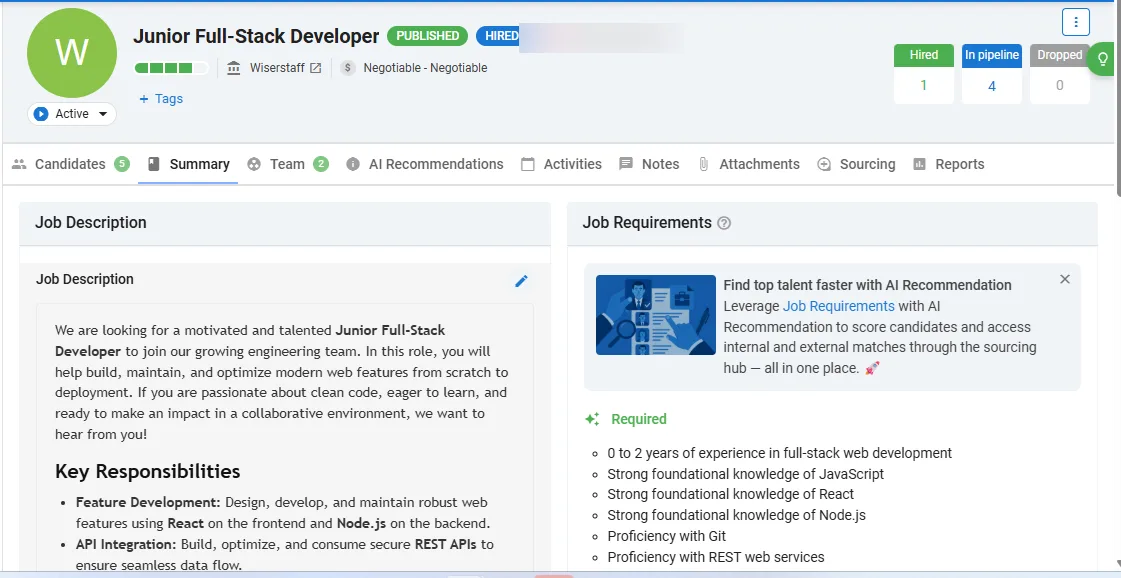
The #1 spot here is earned hands-on. This is my real Manatal workspace from that test run, the pipeline view an agency desk lives in day to day:
The full Manatal review has the complete write-up, tested pricing and score.
At a glance: the agency ATS compared
The table is the decision surface. Prices are deliberately left as a tested figure rather than a vendor’s headline number: every price below is filled in only after a real trial, with the date it was checked. AI sourcing and job-board posting are documented capabilities, not measured counts.
| Tool | Best for | Agency CRM? | AI sourcing | Job-board posting | Free tier / trial | Tested price |
|---|---|---|---|---|---|---|
| Manatal | Best overall for agencies | Yes (built-in) | Yes | Yes (many boards) | Trial | $19 ($15 annual) |
| Zoho Recruit | Best on a budget | Yes (staffing edition) | AI-assisted | Yes (many boards) | Free tier | tested figure pending |
| Breezy HR | Best visual pipeline | In-house first | AI-assisted | Yes (many boards) | Free plan | $189 ($157 annual) |
| Tellent | Best for collaborative hiring | In-house first | AI-assisted | Yes (many boards) | Trial | tested figure pending |
| Workable | Best for sourcing reach | In-house first | Yes | Yes (wide reach) | Trial | tested figure pending |
What a desk actually pays, and what leaving costs
Manatal bills per seat, so an agency desk’s real bill scales with recruiters, not placements. On annual billing: 3 seats ≈ $45/mo, 10 ≈ $150/mo, 25 ≈ $375/mo on Professional, and the tier that unlocks the API and automation (Enterprise Plus) runs roughly 3.7× that. Weigh the seat count you’ll actually run, not the $15 headline. Every published price on this site, with its source and capture date, lives in the HR software pricing index.
Watch the exit as closely as the price. A recruiter’s whole book of business, candidates, clients and placement history, lives inside the ATS, and getting it out cleanly is the part nobody demos. One solo recruiter comparing platforms put the cost trap plainly: “Manatal is streamlined, but it gets so pricey! Every time you add a feature, the price gets unrealistically high” (r/recruiting). Before you migrate onto any tool here, confirm you can export candidates, client records and notes yourself, so your desk isn’t held hostage the day you want to leave.
ATS vs recruitment CRM: what an agency actually needs
An agency needs both a candidate pipeline and a client pipeline, which is the line that splits an ATS from a recruitment CRM.
An ATS (applicant tracking system) moves candidates through a single open job: post, source, screen, interview, hire. That is the in-house need, where you fill your own roles.
A recruitment CRM manages the relationships either side of the placement: the clients who give you the brief, the candidates you keep warm between roles, and the deals in between. That is the agency need, because you are paid for placements, not just for tracking applicants.
In one line: an ATS tracks candidates against jobs; a recruitment CRM tracks the clients and relationships that win those jobs.
Most in-house teams can live in an ATS alone. An agency cannot, because half its work, winning the client and managing the placement, sits outside the candidate pipeline. The tools built for agencies (Manatal, Zoho Recruit’s staffing edition) fold both into one product; the in-house-first tools (Breezy, Tellent, Workable) lead with the ATS and treat client management as lighter. If you only fill your own vacancies, that distinction is exactly why the in-house shortlist (linked in the intro above) is a separate page, and why client management barely registers there.
When you weigh the agency-built tools against the in-house-first ones, four capabilities separate them in day-to-day desk work:
- Client and contact CRM: track the companies, hiring managers, and relationships between roles, not just candidates against a single job.
- Placement and fee tracking: record who was placed where, the fee owed, and split fees when two recruiters share a deal.
- Client-facing shortlists: send a hiring manager a branded shortlist to review, instead of emailing CVs back and forth.
- Invoicing or finance hooks: raise or export an invoice when a placement is confirmed, so billing isn’t a separate spreadsheet.
These are the workflows an in-house ATS treats as afterthoughts. If two or more are core to how you bill, favour an agency-built tool (Manatal, Zoho Recruit’s staffing edition) over an in-house-first one.
One real obligation cuts across all of them: if you handle EU or UK candidate data, the GDPR and UK GDPR apply to how you store CVs, how long you keep them, and the consent you collect. US agencies handling California residents face the CCPA as well. That is a documented legal duty for anyone processing candidate records, so make sure whichever tool you pick lets you set retention rules and honour deletion requests. For where this fits, see where hiring automation sits in the wider HR stack.
How I tested these
Every verdict here comes from running a real agency workflow through the tool, not from reading its marketing page. The test mirrors the job: I create a role, source and parse candidates, move them through stages, and (where the tool supports it) log a client against a placement. Numeric scores appear only after that hands-on run: a tool I haven’t finished testing shows “Review in progress” instead of a score, and its place here is provisional, drawn from documented features rather than my own run. I pay for tools with my own accounts, and the affiliate links on this page never change the order. See the disclosure above this content.
So far Manatal and Breezy have been through that run, in June and July 2026: I posted a real junior full-stack developer role, sourced and triaged candidates in each (Manatal’s AI search alone returned 106 ranked matches), and worked the pipeline through to a hire; the workspace screenshot at the top of the page shows 1 hired and 4 still in pipeline. Tellent has since had a lighter pass, a real published role and a sample-candidate pipeline on its 18-day trial, scored 8/10 with that scope stated. Zoho Recruit and Workable keep their provisional status until the same role has run through them. Because both ran the identical role, the two are directly comparable: Manatal and Breezy HR on the same hire is where the trade-offs sit side by side.
Manatal: best overall for agencies
Manatal is the best all-round pick for a small agency because it covers both halves of agency work, candidates and clients, without enterprise pricing. It is an AI-driven ATS built with recruitment agencies in mind: alongside the hiring pipeline it includes candidate sourcing, AI candidate recommendations, and a CRM layer for managing clients, the combination an agency needs that a pure in-house ATS lacks. It is aimed at SMBs and agencies rather than enterprises, which is why it lands at the affordable end of the market.
In testing it scored 9/10. The AI sourcing is the highlight: a real search returned 106 ranked matches with transparent scores (the top two at 78% and 75%), which makes triaging a long shortlist quick. It loses a point on integrations: automation and the API are locked to Manatal’s upper plans, and it won’t post to LinkedIn or Indeed for you. From $19/user/mo ($15 billed annually), tested June 2026. Full detail is in the Manatal review.
Choose Manatal if you want sourcing, tracking, and a client CRM in one affordable tool. → See Manatal
Zoho Recruit: best on a budget
Zoho Recruit is the budget pick because it ships a dedicated staffing-agency edition alongside its corporate-HR edition, plus a genuinely usable free tier for a single recruiter. For an agency watching every unit of overhead, that combination of agency-specific features and a zero-cost entry point is hard to beat on price. If you’re arriving from the other direction, already on Zoho Recruit and outgrowing it, the Zoho Recruit alternatives shortlist maps that exit with both of Zoho’s price lists captured at source.
The trade-off is that Zoho’s depth can mean a steeper setup, and the value grows when you live inside the wider Zoho suite. Tested verdict pending.
Choose Zoho Recruit if you want agency features at the lowest entry cost. → See Zoho Recruit
Breezy HR: best visual pipeline
Breezy HR is the easiest tool here to get running: a visual, drag-and-drop pipeline that a non-technical team can use on day one, plus a free plan to start. For a tiny agency that wants candidates moving through clear stages without a setup project, it is the simplest on-ramp.
It is in-house-first rather than agency-CRM-first, so client management is lighter than Manatal or Zoho’s staffing edition. If your work is mostly candidate pipeline, that may not matter.
Tested (Jul 2026): 9/10. The first paid tier, Startup, is $189/mo ($157 billed annually), flat-rate, with unlimited positions and unlimited users; only the free Bootstrap plan is capped at one active position. The genuine catch for an agency: Breezy is in-house-first, so client and placement tracking is lighter than Manatal’s built-in CRM. Full hands-on detail in the Breezy HR review.
Choose Breezy HR if an easy, visual pipeline matters more than agency CRM features. → See Breezy HR
Tellent: best for collaborative hiring
Tellent (formerly Recruitee) is a modern, collaborative hiring platform built around bringing recruiters and hiring managers into one shared space. If several people touch each role and you want structured, visible pipelines everyone can work in, it’s a strong fit. Like Breezy, it’s in-house-first, so treat the CRM side as lighter than the agency-built tools.
Now tested at 8/10 in the full Tellent review, on a published role and a sample pipeline; demo-gated pricing is the main catch. Choose Tellent if hiring is a team sport and shared pipelines are the point. → See Tellent
Workable: best for sourcing reach
Workable wins on sourcing reach: it posts to a large number of job boards at once and has solid AI-assisted sourcing, which helps when you need to build a big applicant pool quickly. The common knock is price. It can run more expensive than the others here as you add what you need, so weigh the sourcing reach against the cost for your volume.
Workable’s tested figure and score are pending: its place here rests on documented capabilities until the same role has run through it. If the cost side is what’s pushing you off it, there’s a dedicated page on leaving Workable for a better-shaped bill.
Choose Workable if wide sourcing reach is worth a higher price. → See Workable
On a tight budget? JazzHR
If the deciding factor is cost and you mainly need a no-frills ATS, JazzHR is worth a look: it’s pitched at bootstrapped startups and small teams as a simpler, plan-based alternative to per-feature enterprise pricing. It’s the budget honourable-mention rather than a ranked pick here, because it’s in-house-first and its agency fit is the lightest of the group.
How to choose the right agency ATS
The single most decisive question is whether you need a client CRM or just a candidate pipeline; answer that and most of the shortlist falls away. Pick by your situation, not the feature grid. Four questions decide it for most small recruitment agencies:
- Do you need a client CRM, or just a candidate pipeline? Agencies that manage clients and placements want a built-in CRM, which points to Manatal or Zoho Recruit’s staffing edition. If you only move candidates through stages, an in-house-first tool like Breezy or Tellent is simpler.
- How tight is the budget? Zoho Recruit’s free tier and Breezy’s free plan let you start at zero; Workable sits at the higher end. Decide what you’ll pay after you trial, using the tested figure, not the headline price.
- How many people hire together? On a solo desk, Manatal or Breezy is plenty. A team that hires collaboratively gets real value from Tellent’s shared spaces.
- What’s your hiring volume? Small and growing: these tools fit. High-volume staffing at scale: shortlist a dedicated CRM (Bullhorn, Recruit CRM, JobAdder) alongside them, and treat this list as the affordable end of the market.
If you do one thing before you buy, start a free trial of your top two and run a single real role through each, sourcing to placed, then compare what each actually cost you. The tested number is the line between a recommendation you can trust and a marketing page in disguise.
For where applicant tracking fits alongside the rest of your stack, see the full automation map.
FAQ
What is the best ATS for a small recruiting agency?
For most small recruiting and staffing agencies, Manatal is the best all-round pick: it combines AI candidate sourcing with an agency-style CRM at a price small teams can afford. If budget is the priority, Zoho Recruit has a dedicated staffing-agency edition and a free tier; if you mainly want a fast visual pipeline, Breezy HR is the simplest to run.
What's the difference between an ATS and a recruitment CRM?
An ATS (applicant tracking system) manages candidates against open jobs, which is the hiring pipeline. A recruitment CRM manages relationships with clients and candidates over time, which is what an agency needs to win and service placements. Agency-focused tools like Manatal and Zoho Recruit's staffing edition combine both; in-house-first tools like Breezy and Tellent lean ATS-only.
How much does recruiting agency software cost?
Most SMB-level ATS tools in this round-up are billed per user per month or by the number of active jobs, and several offer a free tier or trial. Exact prices change often, so we publish the figure we paid at the date we tested it rather than a vendor estimate — see each tool's section for the tested number.
What is the best staffing software for a small agency?
Split the question first, because two different products hide behind it. A staffing ATS tracks candidates, jobs and placements; 'staffing software' often also means pay-and-bill, which is timesheets, contractor pay and client invoicing. For the ATS half, Manatal is the best staffing software for most small desks in this round-up, with Zoho Recruit's staffing edition as the budget version. Neither runs pay-and-bill, so a temp desk that invoices weekly needs a dedicated agency platform alongside them.
Can these tools handle temp and contract placements, not just permanent hires?
It varies by tool and edition. Agency-built options like Manatal and Zoho Recruit's staffing edition are designed around client and placement workflows, which is what temp and contract desks lean on. In-house-first tools (Breezy, Tellent, Workable) track candidates against jobs well but treat placement and client management as lighter, so a high-volume temp desk may outgrow them. Confirm contract-placement support with the vendor for your exact model before you commit.
Is a dedicated staffing CRM like Bullhorn better than these?
For high-volume staffing desks, a dedicated agency CRM (e.g. Bullhorn, Recruit CRM, JobAdder) can be a better fit than an SMB ATS, because client management and placement workflows are first-class. The trade-off is cost and complexity. The tools here suit small and growing agencies; if you run a large desk, treat this as the affordable end of the market and shortlist a dedicated CRM too.