Round-up
Best JazzHR alternatives (2026): tested picks for small teams
The best JazzHR alternative for most small teams is Breezy HR: flat $189/mo with unlimited positions and users, tested 9/10. Manatal adds AI sourcing and a built-in CRM at $19/user/mo, tested 9/10. JazzHR's Hero plan is $1,000 a year but covers about three job postings a month; outgrowing it takes the published bill to $3,480.
The best JazzHR alternatives for a small team
JazzHR’s entry plan covers about three job postings a month; the fourth is usually where teams start shopping. The best alternative for most of them is Breezy HR: a flat $189 a month with unlimited positions and unlimited users, so a burst of hiring doesn’t move the bill (see plans), and I’ve tested it hands-on (9/10). Manatal is the pick when the bottleneck is finding candidates rather than tracking them: AI sourcing plus a built-in CRM at $19 per user per month, also tested (9/10). JazzHR itself stays a fair choice for slow, steady hiring, and this page says so plainly.
Almost every page ranking for this search is a listicle of ten to nineteen tools, none of them run first-hand. I don’t sell an ATS. This round-up leads with the two tools I’ve tested with my own account, then names four credible candidates I haven’t, with no invented scores and no invented prices.
Job seeker wondering what JazzHR does with your CV? This page is for the teams running it. How these systems read applications is covered in the glossary entry on what an ATS is.
What JazzHR is, and why teams look elsewhere
JazzHR is a budget-first applicant tracking system for small US businesses: post a role, syndicate it to job boards, run candidates through a pipeline, all with unlimited users on every plan. It is one of four brands owned by Employ Inc., the K1-backed group that also owns Jobvite, Lever and NXTThing RPO; JazzHR is deliberately the small-business tier of that portfolio. For a team that hires one or two roles at a time and mainly needs clean tracking, it does the job at a low price.
The buyer it fits less well is the one this page is for: the founder, office manager or hiring lead whose recruiting comes in bursts. Three patterns push those teams here:
- The job-posting meter. JazzHR prices by hiring volume, not seats. The Hero tier is $1,000 a year with job postings “starting at 3/month” (jazzhr.com/pricing, checked July 2026); Pin’s pricing teardown reads that as a three-job cap, with extra postings at a reported $9 per job per month. Post five roles in the same month and you are either metering past the cap or moving to Plus at $3,480 a year, nearly three and a half times the entry price.
- The reporting gap. The most consistent complaint in JazzHR’s Capterra reviews is reporting that is limited and hard to customise. The vendor’s own feature list bears it out: standard reporting appears only from the Plus tier, and the custom report builder and advanced visual reporting sit on Pro, with advanced reporting sold lower down as a $59-a-month add-on in Pin’s reporting. If you need to show a hiring funnel to anyone, price the tier that can actually produce it.
- The exit friction. Pin reports there is no self-service cancellation: ending a subscription means contacting support. Capterra reviewers also report billing disputes handled slowly. None of this makes JazzHR a scam; it makes the leaving process something to plan rather than click.
Credit where it’s due: unlimited users on every plan is a genuinely generous shape, and at three postings a month Hero undercuts almost everything on this page.
What JazzHR actually costs in 2026
JazzHR publishes its prices, which several teardowns ranking for this search still miss. Everything below is from JazzHR’s own pricing page or attributed to Pin’s reporting; I have not run a JazzHR account myself.
| Item | Figure | Source |
|---|---|---|
| Hero plan | $1,000/yr, postings “starting at 3/month” | JazzHR pricing page, Jul 2026 |
| Plus plan | $3,480/yr, up to 200 active jobs | JazzHR pricing page, Jul 2026 |
| Pro plan | $5,508/yr | JazzHR pricing page, Jul 2026 |
| Monthly billing | ~24% more than annual (vendor’s own savings claim) | JazzHR pricing page, Jul 2026 |
| Extra Hero postings | $9/job/mo (reported) | Pin pricing teardown |
| Candidate texting | $39/mo add-on (reported) | Pin pricing teardown |
| Offers & eSignature | $59/mo add-on below Pro (reported) | Pin pricing teardown |
| Advanced visual reporting | $59/mo add-on below Pro (reported) | Pin pricing teardown |
| Cancellation | Via support only, no self-service (reported) | Pin pricing teardown |
Run the maths for a team posting five roles in the same month. Hero’s $1,000 covers three, so you are either paying the reported per-job meter for the other two or stepping up to Plus at $3,480 before any add-on. The same hiring burst on Breezy’s Startup plan is $1,884 a year (billed annually) with unlimited positions, and on Manatal a three-seat team is about $540 a year with 15 open jobs on the entry plan. The gap is not the entry price, where JazzHR competes well; it is what happens the month your hiring stops being slow.
Who should stay on JazzHR
If you post one to three roles a month, want plain applicant tracking rather than analytics, and like having the whole company in the tool without per-seat charges, JazzHR Hero at $1,000 a year is honestly hard to beat, and its 4.3 to 4.4 star averages say most buyers get what they came for. The alternatives below earn their place when the posting cap, the reporting ceiling or the add-on ladder starts costing more than the headline saves.
How I chose these
I only score tools I’ve run with my own account, so this list splits in two. Breezy HR, Manatal and now Tellent carry tested verdicts from their own hands-on reviews; the process is documented in how WiserStaff tests tools. Zoho Recruit, Workable and Greenhouse are credible candidates I haven’t run, so they appear with no scores and no third-hand prices. Affiliate links are disclosed above this content and never change a ranking; the three untested tools carry no affiliate relationship on this page.
Pick by what your team actually needs
A flat bill and reporting you don’t pay extra for → Breezy HR
Breezy answers JazzHR’s two sore points in one move. Pricing is flat by plan, not by posting: the Startup tier is $189 a month ($157 billed annually) with unlimited positions and unlimited users, so a hiring burst changes nothing on the invoice. And reporting ships with the plan a small team actually buys rather than arriving as an add-on. This is the reporting view from my own test, after running a real role to a hire:
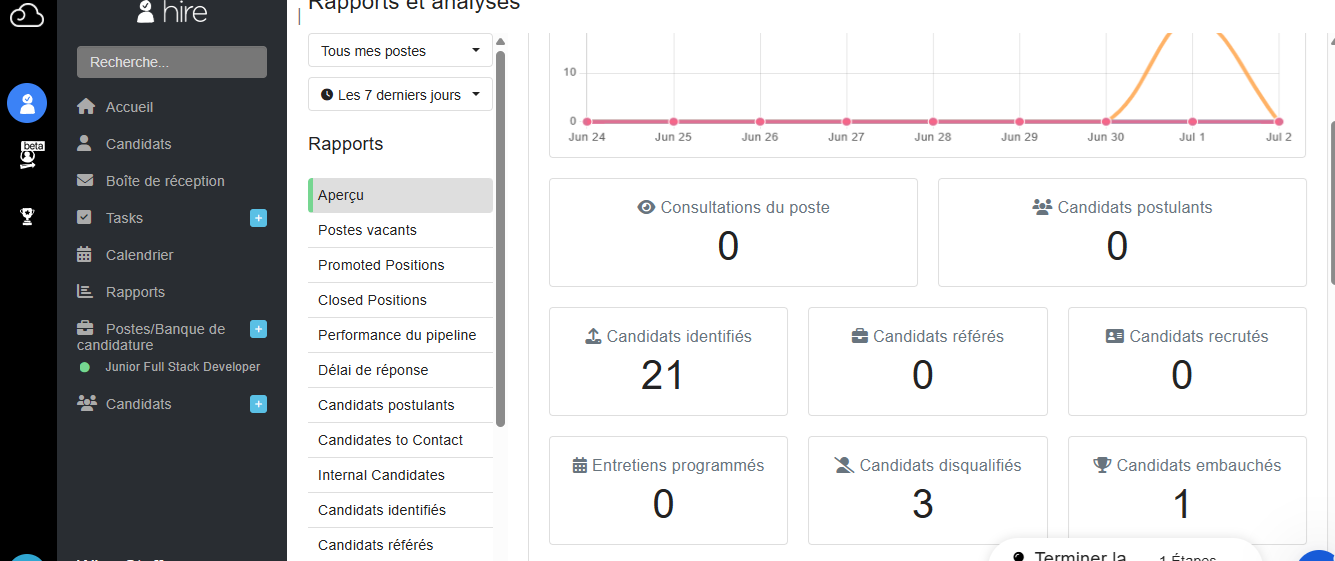
Tested (Jul 2026): 9/10. The free Bootstrap plan runs one active position with unlimited users and candidates, indefinitely, which makes it the cheapest real exit from JazzHR on this page. The honest caveat from my test: AI candidate scoring and API access are paid extras, not part of the base plan. Full detail in the Breezy HR review. → See Breezy HR
Like JazzHR, Breezy is built for in-house hiring, so nothing about your workflow has to change shape; what changes is that the meter stops running per posting.
AI sourcing plus a built-in CRM → Manatal
Manatal is the pick when tracking applicants isn’t the problem, finding them is. It pairs the pipeline with AI candidate matching and a client-style CRM: in my test the AI search returned 106 ranked matches for one role, with the match scoring visible rather than black-box.
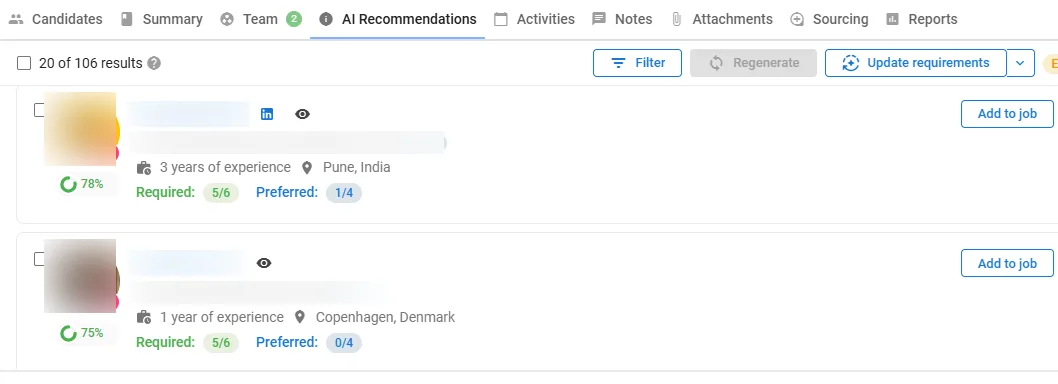
Tested (Jul 2026): 9/10. From $19/user/mo ($15 billed annually) on Professional, which caps you at 15 open jobs and 10,000 candidates, room JazzHR Hero’s three-postings-a-month allowance doesn’t offer, at roughly half Hero’s price for a three-seat team. Automation and the API sit on upper plans. Full detail in the Manatal review. → See Manatal
One caution in the other direction: Manatal bills per user, so a company that wants fifteen colleagues in the ATS pays for fifteen seats, where JazzHR and Breezy would not. Count your real users before comparing bills.
At a glance: JazzHR alternatives compared
Prices are the real, dated figures from the tools I’ve reviewed; untested tools show no price and no score on purpose.
| Tool | Pricing model | Free tier / trial | Tested price | My status |
|---|---|---|---|---|
| Breezy HR | Flat, by plan | Free plan | $189/mo flat ($157 annual) | Tested 9/10 |
| Manatal | Per user | Trial | $19/user/mo ($15 annual) | Tested 9/10 |
| Zoho Recruit | Per user | Free tier | not tested | Not yet tested |
| Tellent | Demo-gated | Trial | demo-gated | Tested 8/10 |
| Workable | Flat tiers by headcount | Trial | not tested | Not yet tested |
| Greenhouse | Quote-only | No | not tested | Not yet tested |
| JazzHR (baseline) | By job postings | Trial | $1,000–$5,508/yr published (Jul 2026) | Baseline |
Still on my list to test
Credible candidates I haven’t run myself, so no scores and no unverified prices.
Zoho Recruit
The zero-cost route: a genuine free tier for a single recruiter and per-user paid plans above it, with the bonus of living inside the wider Zoho suite if you already use it. If your JazzHR question is really “why am I paying at all for two roles a year”, this is the first trial to run. And if you land there and outgrow it, the tested Zoho Recruit exits page covers the reverse trip.
Tellent
The collaborative pick, formerly known as Recruitee: shared scorecards, custom Kanban pipelines and a careers-page builder, with GDPR tooling that suits EU and UK hiring. Its pricing is demo-gated, so no figures here. Strongest when a hiring manager and a recruiter work the same role together. Since this page first ran, I’ve tested it hands-on: 8/10 in the Tellent review.
Workable
The sourcing-reach pick: a large candidate database and broad syndication, at prices set by company headcount rather than postings. It sits at the premium end of the SMB bracket; the published tier maths is broken down in the Workable cost teardown.
Greenhouse
The structured-hiring pick for teams outgrowing the SMB bracket entirely: interview kits, scorecards and process discipline at scale. Pricing is quote-only, and for a three-person hiring team it is almost certainly more process than you need. It belongs on this list because JazzHR leavers heading upmarket end up evaluating it; before you book that demo, the Greenhouse exits round-up prints what its buyers report paying.
How to leave JazzHR without losing your data
The reported friction is the process, not the export, so work the process first.
- Get cancellation terms in writing before you trial anything. Pin reports there is no self-service cancellation, so email JazzHR support early, ask how notice works and when billing stops, and keep the reply. Capterra reviewers report billing disputes resolving slowly; a paper trail is cheap insurance.
- Export while access is live. Candidates, jobs, notes and reports. Do it before giving notice, not after.
- Verify a sample import in the new tool. Load one role and fifty candidates into your trial account and check that notes and stages survived, on fifty records rather than five thousand.
- Run one hiring cycle in parallel. Keep JazzHR read-only while a full role runs through the new system. The Freshteam shutdown guide walks the same parallel-run playbook under a harder deadline.
Which JazzHR alternative should you choose?
Decide on the shape of your hiring, then on the tool. If roles come in bursts and you want the meter gone, Breezy HR’s flat $189 a month (with a free single-position plan to start) is the tested pick. If finding candidates is the real problem, Manatal adds AI sourcing for $19 a user. If the answer must be free, start with Breezy’s Bootstrap plan or Zoho Recruit’s free tier and prove the fit before paying anyone; which ATS free tiers are genuinely free, and which are trials on a clock, has its own tear-down. And if you post three roles a month or fewer, staying on JazzHR Hero is a defensible answer this page won’t argue you out of. For the wider field beyond JazzHR leavers, the full in-house ATS shortlist ranks the same market from a clean slate; founders buying their first ATS for a team that’s still doubling should start from the ATS shortlist for startup trajectories instead. The pillar guide maps where an ATS sits among the hiring and HR processes worth automating.
FAQ
What is JazzHR?
JazzHR is an applicant tracking system aimed at small and mid-sized US businesses: job posting and syndication, candidate pipelines and interview scheduling, with unlimited users on every plan. It sells three tiers (Hero, Plus, Pro) priced by hiring volume rather than seats, and it is one of four recruiting brands owned by Employ Inc., alongside Jobvite, Lever and NXTThing RPO.
Who owns JazzHR?
Employ Inc. owns JazzHR. The private-equity firm K1 Investment Management combined Jobvite, JazzHR and NXTThing RPO into Employ Inc., which then added Lever in 2022. Inside that portfolio JazzHR is deliberately the small-business tier, with Lever and Jobvite serving larger companies, which is useful context for its roadmap: it is built to stay simple, not to grow enterprise features.
Is JazzHR legit?
Yes. JazzHR is an established small-business ATS owned by Employ Inc., rated 4.4/5 on G2 and 4.3/5 on Capterra as of July 2026. The recurring complaints are not about trust: reviewers flag limited reporting that is hard to customise, and a cancellation process that requires contacting support rather than a self-service button. It is a legitimate tool with a specific, budget-first shape.
How much does JazzHR cost in 2026?
JazzHR publishes three annual plans, checked July 2026: Hero at $1,000 per year with job postings starting at 3 per month, Plus at $3,480 with up to 200 active jobs, and Pro at $5,508. JazzHR says annual billing saves 24% against monthly. Pin's pricing teardown reports extra Hero postings at $9 per job per month and paid add-ons including candidate texting at $39 and advanced reporting at $59 per month.
What is the cheapest JazzHR alternative?
Breezy HR's free Bootstrap plan is the cheapest genuine start: one active position with unlimited users and candidates, indefinitely. Zoho Recruit also has a free tier. Among tools I've tested hands-on, Manatal's Professional plan at $15 per user per month billed annually means a three-person hiring team pays about $540 a year, against JazzHR Hero's published $1,000.