Round-up
Best Rippling alternatives (2026): tested picks by use case
The best Rippling alternative depends on which slice you actually use. Gusto is the tested pick for US payroll and HR, Deel for global payroll and EOR (employer of record), Breezy HR or Manatal for hiring. Budget first: Rippling is quote-only, and independent buyers report real costs well above its $8/employee headline.
The best Rippling alternatives by use case
The best Rippling alternative depends on which slice of Rippling you actually use. For US payroll and core HR, Gusto is the tested pick. For global payroll and EOR hiring, Deel is the global-first answer (see Deel’s plans). If the module doing the real work is recruiting, Breezy HR and Manatal beat a platform bolt-on at a fraction of the price. Rippling itself is a strong product; the case for leaving is usually cost and fit rather than quality, and it starts with a pricing model no ranking page on this query bothers to explain.
Worth saying up front: most pages ranking for this search are vendor blogs that conclude you should buy the vendor writing the page. I don’t sell any of these tools. This round-up leads with the four I’ve tested hands-on, then names the credible candidates I haven’t, with no invented scores.
What Rippling is, and why teams go looking
Rippling is a workforce-management platform that spans HR (payroll, benefits, time, recruiting), IT (device provisioning, app access, single sign-on) and finance (cards, expenses), built around a single employee record that drives automations across all three (Sacra). It was co-founded in 2016 by Parker Conrad, raised at a $16.8 billion valuation in May 2025 (TechCrunch), and offers EOR hiring in 80 countries with contractor coverage across 185+ (Sacra).
Teams shop for alternatives for four reasons, and the independent review platforms agree on all of them:
- Support. Buyer-research firm Outsail (March 2026) calls customer-support inconsistency “the most frequent complaint” among Rippling buyers.
- Pricing opacity. GetApp’s review summary flags opaque modular pricing with unexpected fees. In practice, the table below shows totals landing well above the $8 headline once add-ons are counted.
- Cost escalation. Software Advice’s negative-review themes include per-employee costs that climb as modules stack, and criticism of payroll reliability.
- The recruiting module. Outsail’s same report judges Rippling’s built-in ATS “not best-in-class” against dedicated recruiting platforms.
Software Advice still scores Rippling 4.9/5 across 4,836 verified reviews. This is a liked product with sharp edges, and the sharpest edge is the bill.
What Rippling actually costs (the picture nobody publishes)
Rippling is quote-only: there is no public price list, and its pricing page blocks automated checks, so what follows is the independent, dated picture rather than an official one. GetApp lists the Core plan from $8 per user (employee) per month. Outsail (March 2026) adds a $35 monthly base fee, puts realistic mid-market totals at $15–$25 per employee per month with common modules, and $30–$50+ for the full stack. Vendr’s purchase data across 278 Rippling contracts shows add-on modules running roughly $4–$12 per employee each and a median annual contract of $45,862.
| What | Independent figure (checked Jul 2026) | Source |
|---|---|---|
| Core platform | from ~$8/employee/mo | GetApp |
| Base fee | +$35/mo | Outsail (Mar 2026) |
| Add-on modules | ~$4–$12/employee/mo each | Vendr |
| Realistic mid-market total | $15–$25/employee/mo | Outsail |
| Full stack | $30–$50+/employee/mo | Outsail |
| Median annual contract | $45,862 (278 purchases) | Vendr |
The buyers living it put the numbers in plainer words. One Rippling user on Capterra: “I don’t love that all items are separated by modules. The pricing can get quite high if you add every little item” (Capterra) — that modular structure is exactly what turns the $8 headline into the $15–$25 reality. That gap is the single most useful thing to know before a Rippling sales call, and it’s the frame for the tested picks below: all four publish their prices.
Who should stay on Rippling
A tech-forward, multi-state US company of roughly 50 to 1,000 people that actively uses the HR-plus-IT combination (accounts provisioned on day one, devices managed from the employee record) should probably stay on Rippling. That’s Outsail’s fit profile, the 4.9/5 rating says users who fit it are happy, and an honest round-up says this part too. The alternatives below are for everyone the platform pitch doesn’t fit: the team using one module, the team that can’t budget a quote-only contract, and the team that just wants a human in support.
How I chose these
I only score tools I’ve tested with my own account, so this list splits in two. Gusto, Deel, Breezy HR and Manatal carry tested verdicts from their own reviews; the full process is documented in how WiserStaff tests tools. BambooHR, Paylocity and Workday are credible candidates I haven’t run, so they appear without scores or invented prices. Affiliate links are disclosed above this content and never change a ranking; one tested pick, Gusto, carries no affiliate relationship at all, and it leads this page anyway.
Pick by the slice of Rippling you actually use
Rippling sells a platform, but most teams buy it for one job. Replace the job, not the platform. One honest gap before the picks: nothing here replaces Rippling’s IT half. If device management and app provisioning are the modules you actually use, you’d pair an HR tool below with a dedicated device-management product (Jamf and Kandji are the usual names; I haven’t tested either), and that pairing deserves its own maths before you leave.
US payroll and core HR → Gusto
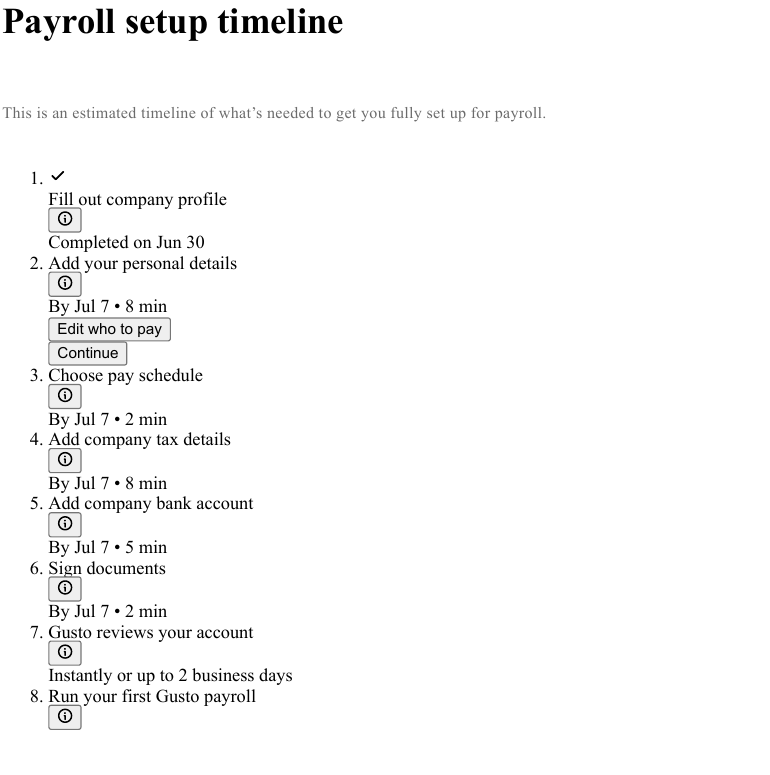
If the honest job is “pay a US team correctly and keep the records straight”, Gusto does it with published pricing and no sales call, which is precisely the contrast with a quote-only platform. (Weighing Gusto against other payroll routes first? The Gusto alternatives round-up sorts them by exit reason.)
Tested (Jul 2026): 8/10. Transparent pricing from $49/mo +$6/person (Simple). Full-service payroll, strong employee self-onboarding; the weak spots are support and HR features that turn into paid add-ons. US-only for employee payroll. Full detail in the Gusto review. No affiliate relationship, which changes nothing about the verdict.
Global payroll and EOR → Deel
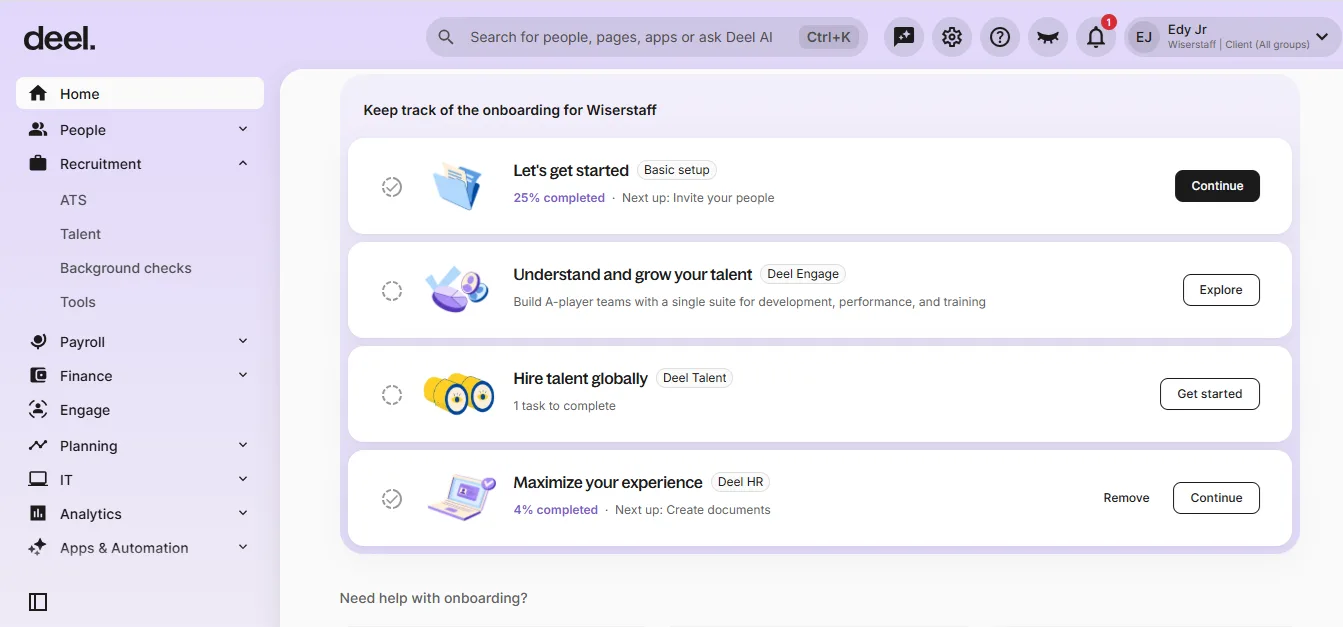
For a distributed team, Deel is the global-first version of what Rippling bolts on: payroll and contractor payments across 150+ countries, with employer-of-record hiring through its own entities in 130+ of them. Whether EOR is even your right model, versus a US PEO, is a separate decision — the EOR vs PEO guide walks you through it.
Tested (Jul 2026): 8/10. I set up a real account and posted a live job through Deel’s recruiting flow. Deel HR from $14/worker/mo (list); EOR from $599/employee/mo, plus salary, employer taxes and FX on top. Full detail in the Deel review. → See Deel
Full disclosure, because no other page ranking for this query mentions it: Rippling sued Deel in March 2025 alleging trade-secret theft, and Deel countersued a month later (background). Neither suit changes what either product does day to day, but you should know the two loudest vendors in this market are in open legal conflict, and read both companies’ marketing accordingly.
Hiring → Breezy HR or Manatal
Outsail’s finding that Rippling’s built-in ATS is “not best-in-class” is exactly the gap dedicated recruiting tools exist to fill. If recruiting was the module earning Rippling its seat, replace it directly.
Breezy HR gives a non-recruiter a visual pipeline that runs itself: Kanban board, a genuinely free starter plan, one-click posting to 50+ job boards.
Tested (Jul 2026): 9/10. Free Bootstrap plan for one active position; the Startup tier is $189/mo flat ($157 billed annually) with unlimited positions. AI scoring and the API cost extra. Full detail in the Breezy HR review. → See Breezy HR
Manatal adds AI candidate scoring and a recruitment CRM at an SMB price; it’s the budget pick when sourcing matters as much as tracking.
Tested (Jul 2026): 9/10. From $19/user/mo ($15 billed annually) on Professional. Transparent AI scoring; automation and the API sit on upper plans. Full detail in the Manatal review. → See Manatal
Choosing between more ATS options? In-house teams should start from the best ATS software round-up; recruiting and staffing agencies have a separate agency ATS shortlist.
At a glance: Rippling alternatives compared
Prices are the real, dated figures from the tools I’ve reviewed; untested tools show no price and no score on purpose.
| Tool | Replaces which Rippling job | Pricing transparency | Tested price | My status |
|---|---|---|---|---|
| Gusto | US payroll + core HR | Published | $49/mo +$6/person | Tested 8/10 |
| Deel | Global payroll + EOR | Published headline fees | HR from $14/worker/mo | Tested 8/10 |
| Breezy HR | Recruiting module | Published | $189/mo flat ($157 annual) | Tested 9/10 |
| Manatal | Recruiting + AI sourcing | Published | $19/user/mo ($15 annual) | Tested 9/10 |
| BambooHR | HRIS core | Published | not tested | Not yet tested |
| Paylocity | Mid-market payroll suite | Quote-based | not tested | Not yet tested |
| Workday | Enterprise HR platform | Quote-based | not tested | Not yet tested |
Still on my list to test
Credible candidates I haven’t run myself, so no scores and no unverified prices.
BambooHR
The HRIS-first route: employee records, hiring and onboarding with published per-seat pricing of $10–$25 per employee per month, plus a flat rate from $250/mo for teams of 25 or fewer (BambooHR’s own published prices, verified July 2026). It’s the anti-platform pick, and it has its own decision page here: the BambooHR alternatives round-up works in both directions, mapping when BambooHR is the answer and when it isn’t. If onboarding is the module you’d actually miss, the dedicated picks live in the onboarding software shortlist for small teams.
Paylocity
A US mid-market payroll incumbent (it ranks on this query with its own competitor list, which tells you who it thinks it’s competing with). The usual candidate when a 100-plus-person team wants an established payroll suite rather than a modular platform.
Workday
The enterprise ceiling. Once an organisation passes roughly a thousand people, HR software buying becomes a procurement project, and Workday is that market’s default; below it, Workday is more system than most teams can use. ADP and Justworks also earn shortlist mentions: ADP as the payroll incumbent, Justworks if the actual question is “should a PEO run this?”, a call the PEO-or-EOR decision page covers.
How to switch off Rippling
Switching off Rippling takes four steps: get the full quote in writing, check your contract’s exit terms, export everything while access is live, and run one payroll cycle in parallel. It’s the practical part missing from nearly every page on this query.
- Get the full quote in writing first. Module by module, with the base fee and per-employee lines separated, so the comparison against published-price tools is honest.
- Check your contract’s exit terms. Quote-only platforms mean negotiated terms; know your renewal date and notice period before you plan a cutover.
- Export everything while access is live. Employee records, payroll history, documents. If IT provisioning runs through Rippling, inventory which apps and devices depend on it; that dependency, not the data export, is usually the hard part of leaving.
- Run one payroll cycle in parallel. Keep the old system read-only through a full cycle on the new one. The same sequencing applies to any HRIS move, as covered in the BambooHR switching checklist.
Which alternative should you choose?
Replace the job, not the platform: US payroll and HR points to Gusto, global teams to Deel, and hiring to Breezy HR or Manatal. If the HR-plus-IT combination is in daily use and you fit the 50–1,000-person profile, staying on Rippling is a defensible answer; just make the sales team put the whole bill in writing first.
For where these tools sit in a wider automated stack, see which HR workflows to automate first.
FAQ
How much does Rippling cost per month?
Rippling doesn't publish a full price list; everything is custom-quoted. Independent buyer research puts the core platform at around $8 per employee per month plus a $35 monthly base fee, with add-on modules of roughly $4 to $12 per employee each, and realistic mid-market totals of $15 to $25 per employee per month. Vendr's purchase data shows a median annual contract of $45,862. Figures are third-party price checks from July 2026, not Rippling's own list.
Is BambooHR better than Rippling?
They solve different problems. BambooHR is an HRIS first: employee records, hiring and onboarding, with published per-seat pricing and US-only payroll as an add-on. Rippling is a broader HR, IT and finance platform with quote-only modular pricing. A team that wants simplicity and a predictable bill leans BambooHR; a team that wants one system driving app access, devices and pay leans Rippling.
Why are companies switching away from Rippling?
The complaint pattern across independent review platforms is consistent: customer-support inconsistency is the most frequent issue, pricing is opaque and modular so totals land higher than expected, per-employee costs escalate as modules stack, and the built-in ATS trails dedicated recruiting platforms. None of that makes Rippling weak — its overall ratings are excellent — but each one maps to a focused alternative.
What is the best Rippling alternative for small businesses?
For a US small business whose real need is payroll and core HR, Gusto: transparent pricing from $49 a month plus $6 per person, tested at 8/10. If the only module you really used was recruiting, a dedicated ATS is cheaper still: Manatal from $19 per user per month, or Breezy HR with a genuinely free starter plan.
Who are Rippling's biggest competitors?
In practice: Gusto for US SMB payroll and HR, Deel for global payroll and employer-of-record hiring, BambooHR for HRIS-first simplicity, ADP and Paylocity among the US payroll incumbents, Workday at the enterprise end, and Justworks on the PEO route. Which one is the real competitor depends on which Rippling module a team actually buys.
What happened between Rippling and Deel?
In March 2025 Rippling sued Deel, alleging trade-secret theft, and Deel countersued in April 2025. Both companies continue to operate and compete worldwide. The two are the loudest names in this market, so any page recommending either one should say so openly, which is what this page does.