Review
Deel review (2026): EOR pricing, real costs & verdict
Deel is an all-in-one global-hiring platform (employer of record, contractor management, global payroll, HR and IT) across 150+ countries from one login. I set up a real account and posted a job; it scores 8/10 on what I verified plus documented behaviour: unmatched coverage and openly published pricing, held back by the highest fees here and a real cost well above the $599 headline.
Pros
- The widest coverage here: EOR in 130+ countries through Deel's own legal entities, plus contractor payments and payroll across 150+ countries from one login
- Genuinely all-in-one: EOR, contractor management, global payroll, HR/HRIS, IT device management and immigration in a single system
- Headline pricing is actually published (EOR $599, contractors $49, payroll $29), which rivals usually hide behind a sales call
- 130+ native integrations plus a strong compliance posture (SOC 2, ISO 27001, GDPR); top third-party ratings (G2 4.8, Capterra 4.9)
- A fast, low-friction contractor onboarding process and a clean account setup I could walk through without speaking to sales
Cons
- The most expensive option here: EOR starts at $599/employee/mo (Enterprise reported at $899), well above payroll-only tools
- The $599 is a platform fee only: real cost adds salary, local employer taxes, an FX spread, a refundable deposit and country-specific surcharges
- Several products are sales-gated (US PEO, US payroll, IT, and the fuller HR/HRIS pricing), so you can't self-serve a full quote
- Breadth means a learning curve, and independent reviews report support quality dipping at scale or during peak payroll
- EOR runs through local partner entities in some markets rather than Deel's own, so the compliance model varies by country
Is Deel worth it?
Deel is an all-in-one global-hiring platform: it employs people on your behalf as an employer of record (EOR), pays contractors and runs payroll across borders, and folds in HR, IT and immigration, all from one login. For a team hiring internationally it removes the single hardest barrier, standing up a legal entity in each country, and it does so with the widest coverage in this round-up and, unusually, headline prices published in the open. After I set up a real account and posted a job, it lands at 8/10: excellent reach and all-in-one convenience, held back by being the most expensive option here and by a real cost that sits well above the $599 you see first. If you are sizing it for a cross-border team, Deel publishes its current plans as you read.
What I could and couldn’t test: I created a real Deel account, walked its dashboard and product surface, and posted a live job through Deel’s recruiting flow. I did not run a full candidate-to-hire workflow (candidates are being sourced through Deel’s talent partners) or complete a live EOR hire or payroll run, which would need a genuine cross-border employee and budget. So I score only what I verified first-hand (sign-up, dashboard, the hiring/ATS surface, and Deel’s published pricing) and lean on Deel’s documented behaviour and the consensus of independent reviews for the rest. I’d rather scope that openly than pretend otherwise.
What Deel is, and who it’s for
Deel sits in the global-employment corner of the HR-software market. It is built for companies that hire people in countries where they have no legal entity, whether as employees (through EOR) or as contractors, and want the contract, compliance, payroll and benefits handled for them. On the same platform it adds core HR, device management and visa support, so a distributed team can run most of its people operations in one place. Deel says it serves more than 35,000 customers and over 1.5 million workers across 150+ countries, and it raised at a $17.3 billion valuation in October 2025 (Deel; TechCrunch).
It is the right shape for:
- A company making its first international hire without opening a foreign subsidiary.
- A distributed team paying contractors or employees across multiple countries who wants one system, not a patchwork.
- A business that wants payroll, HR, IT and immigration consolidated rather than stitched together.
It is the wrong shape for a US-only team that just needs domestic payroll (a focused tool like Gusto, tested at 8/10, is cheaper and simpler), or for a budget-conscious startup where the platform fee plus local on-costs is hard to forecast.
What Deel does well
Deel’s strength is putting global hiring, payment and HR in one platform with coverage no rival in this round-up matches.
- Owned-entity EOR reach. Deel employs people through its own legal entities in 130+ countries (and markets 150+ countries for contractor and payroll coverage), which is the widest direct network here. Its own pricing page frames EOR as “full legal employment in 130+ countries” and payments in “120+ currencies” (Deel pricing).
- All-in-one. EOR, contractor management, global and US payroll, HR/HRIS, IT device management and immigration live in one system, so a new hire’s contract, accounts and payroll flow from a single record instead of three disconnected tools.
- Published headline pricing. Deel lists its core platform fees openly (EOR from $599, contractors from $49, payroll from $29), which most competitors in this category hide behind a demo. That transparency is rare and useful, even with the caveats below.
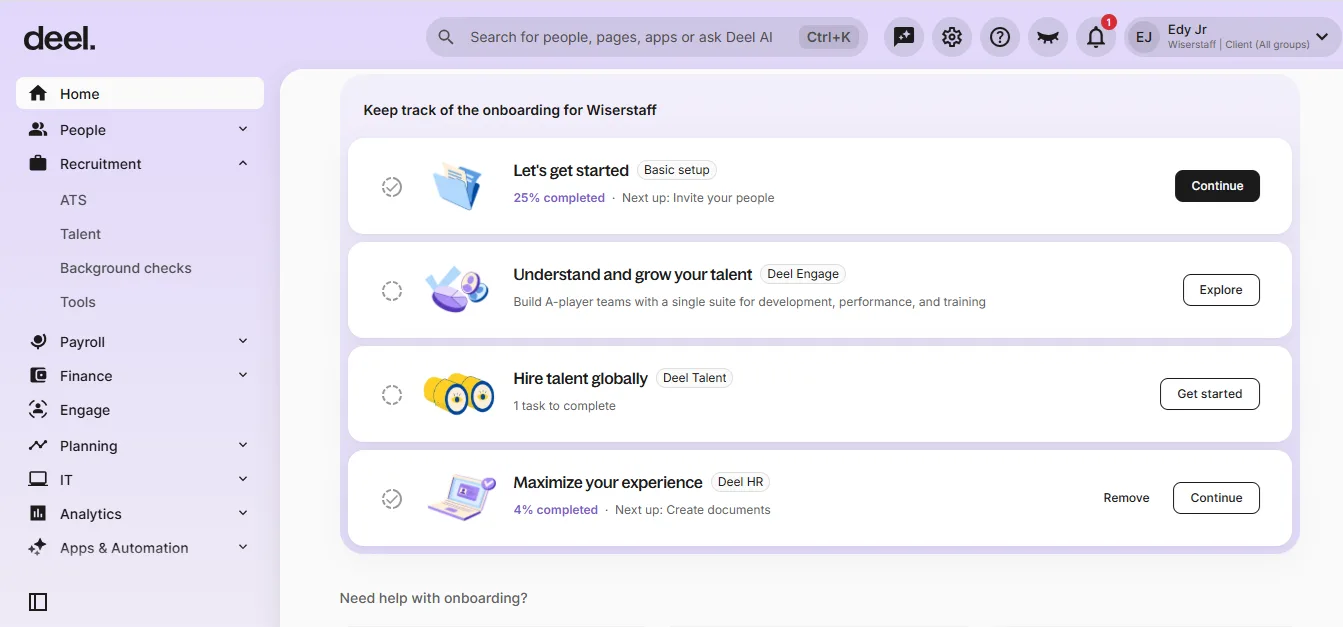
As I set up the account, the breadth was obvious: the left-hand nav carries People, Recruitment, Payroll, Finance, Engage, Planning, IT, Analytics and an automation layer, and the home screen runs a staged onboarding checklist. For a team consolidating tools, that single-login sprawl is the whole point; for a team that only needs one job done, it is more than they will use.
Setting up Deel and posting a job
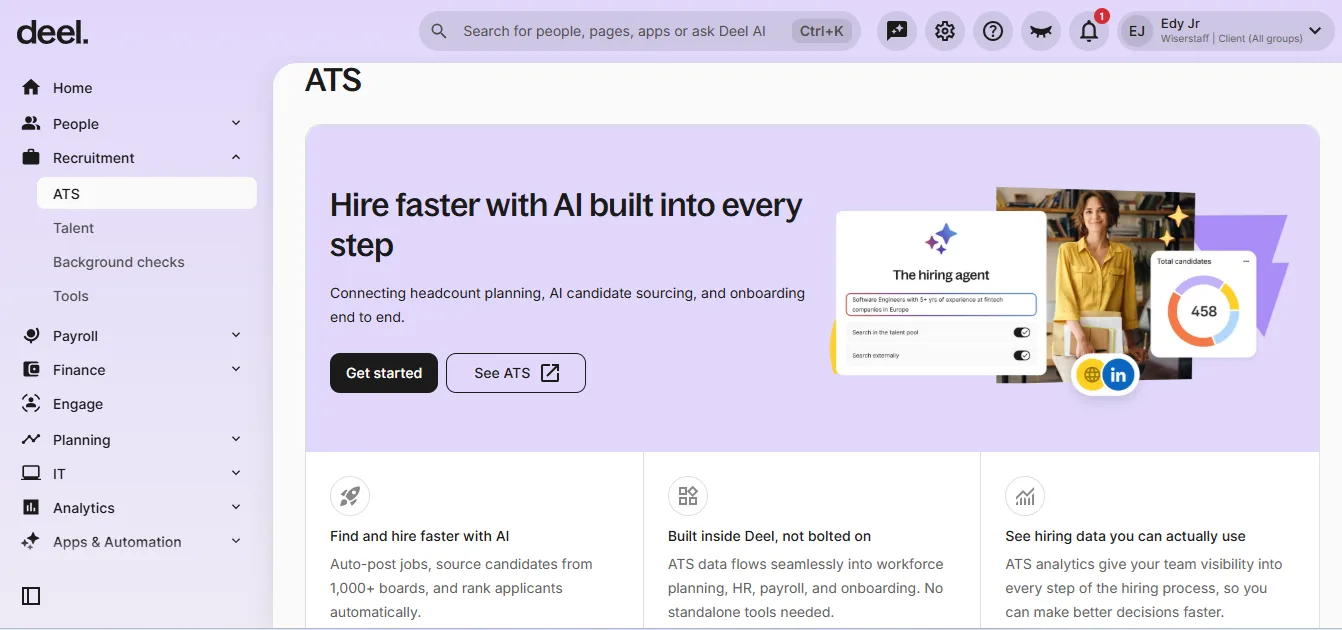
Account setup is smooth and self-serve. You reach a working dashboard quickly, and Deel’s Recruitment section includes an ATS built around AI sourcing (“auto-post jobs, source candidates from 1,000+ boards, and rank applicants automatically”) plus a Talent option that routes a role to Deel’s network of vetted recruiting partners.
I posted a real role through this flow: a Junior Full Stack Developer, set live on 7 July, engaging two of Deel’s talent partners to source candidates. What the screen shows is the honest state of my test, and the reason for the scope box above: the job is live, but at the time of writing it sits at 0 hires and 0 of 2 partners accepted, so the candidate pipeline hasn’t started. That is exactly why I score the hiring workflow on documented behaviour rather than a completed run.
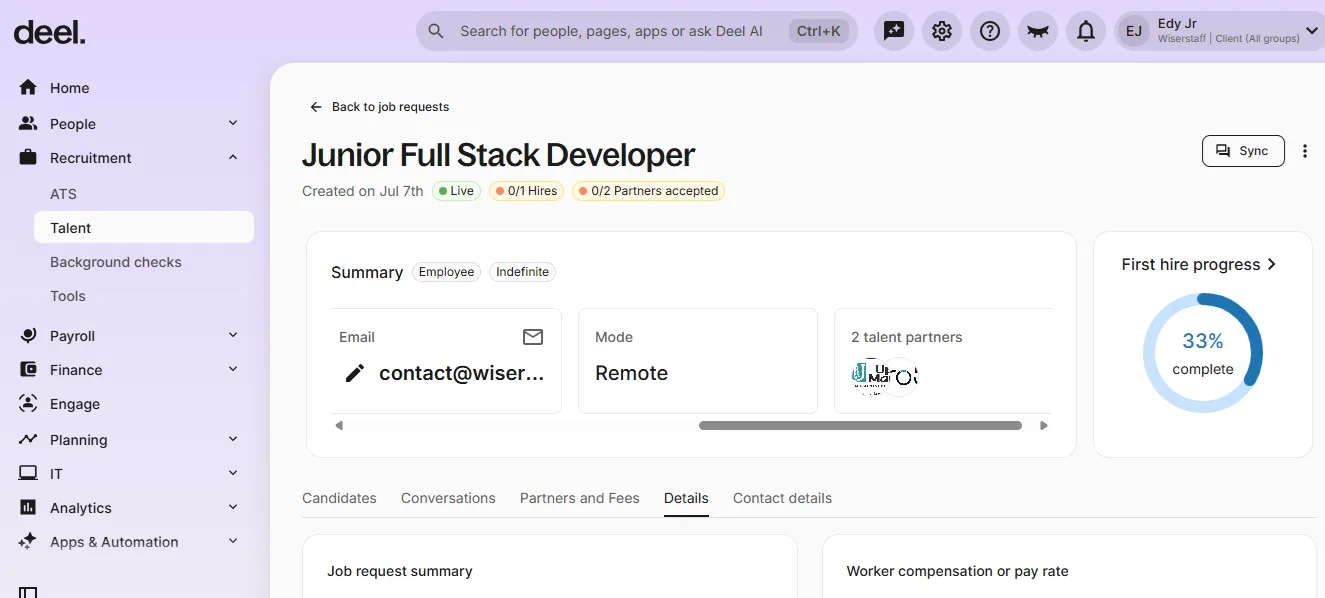
Transparency note (updated July 2026): This posting was a test to document how Deel Talent works, not a live hiring need. WiserStaff is a one-person editorial site with no engineering vacancy. After I’d captured how the flow works, I closed the posting so no recruiting partner would keep sourcing for a role that was only ever a test. One signal worth recording for the review: one of the two talent partners, Pro5, reached out directly within a day of the post going live, which says something fair about how quickly the network responds.
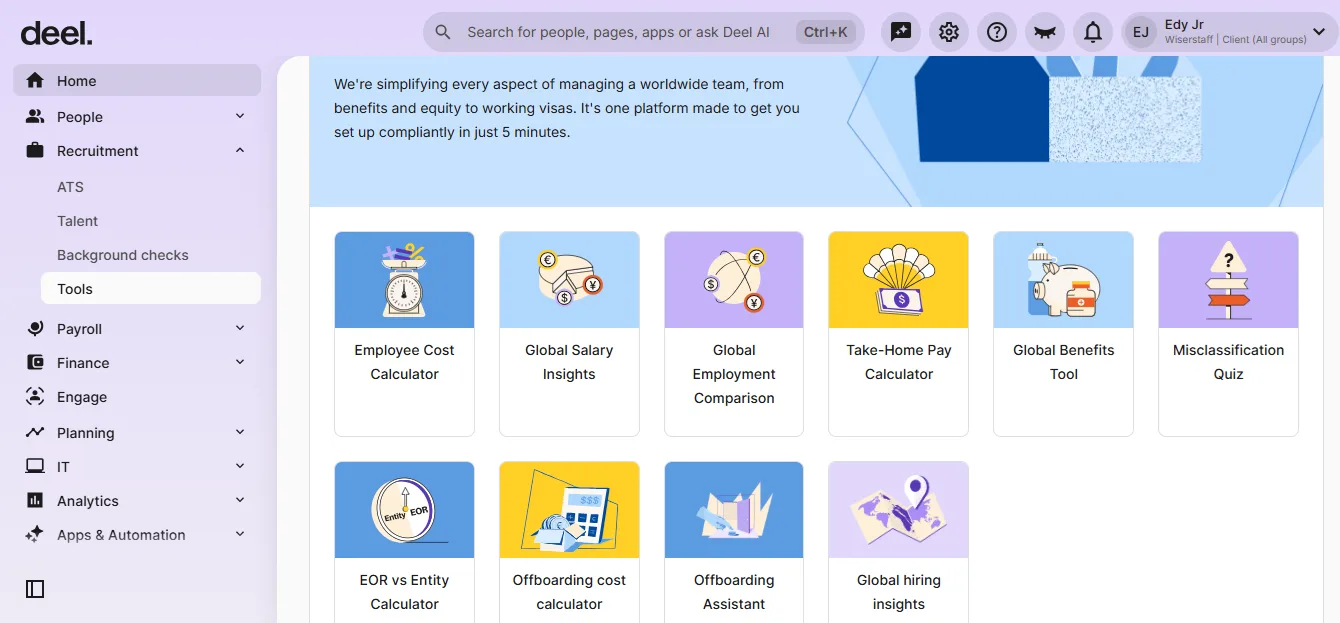
One useful detail most reviews skip: Deel bundles a set of free recruitment and cost tools into the account (an employee-cost calculator, a global-employment comparison, a take-home-pay calculator, a misclassification quiz, an EOR-vs-entity calculator, plus global salary insights, a global-benefits tool and offboarding helpers). They’re a fair way to sanity-check the real cost of a hire before you commit, which matters more with Deel than with most tools here.
Deel pricing in 2026: what you’ll actually pay
Pricing is where Deel is both clearer and trickier than rivals. Deel publishes its platform fees, which is welcome, but the platform fee is only part of the bill. These are Deel’s list prices, captured July 2026; treat them as the starting line, not the total.
| Product | Published price | What it’s for |
|---|---|---|
| Contractor management | $49 / contractor / mo | Compliant contractor payments and tax filings |
| Contractor of Record | $325 / contractor / mo | Deel takes on misclassification risk for contractors |
| Global payroll | $29 / employee / mo | Payroll where you already own the entity |
| US PEO | $125 / employee / mo | Co-employment (professional employer organization) for US teams; when a PEO beats an EOR |
| Employer of Record (EOR) | from $599 / employee / mo | Deel employs the person for you where you have no entity |
| HR, hiring & ATS | from $14 / worker / mo | Core HR and hiring tools; fuller HRIS is quote-only |
One promotion is worth reading in full before the PEO line tempts you. Deel offers three months of complimentary platform fees on qualifying PEO orders signed between 15 July and 31 December 2026, but the terms attached to it change the offer: it requires a minimum two-year term, the credit lands at the end of that term rather than up front, it is non-transferable, and if you terminate early you owe Deel the full list price for the entire order form, promotional credit included, as a non-waivable condition (Deel’s pricing-page terms, captured 27 August 2026). Three free months collected two years out, against a two-year lock and a full-price clawback, is a different proposition from three free months at the start.
Deel EOR pricing: what the $599 actually covers
Two things to know before you budget. First, the $599 EOR fee is a platform fee only: it is the charge for the EOR service itself, not for the person you employ. On top of it you pay the employee’s salary, local employer taxes and statutory contributions (which vary widely by country and can add double-digit percentages), a currency-conversion spread, a refundable deposit of about one month’s cost, and surcharges in some markets. So a full-time employee on a $6,000 salary is not a $599 line; it is $6,599 before local on-costs. Independent reviews put the FX spread at roughly 0.5–2% and country surcharges at $50–150 in some markets — figures reported by third parties that I have not verified first-hand, so treat them as a ballpark and confirm your own in a real quote. Deel’s own free calculators (above) exist precisely because this total is hard to eyeball.
Second, some figures are demo-gated or disputed. Deel’s Enterprise EOR tier is reported at $899 by third parties but isn’t shown on the public page. Several products are quote-only: US PEO, US payroll, IT and the fuller HR/HRIS tiers. And reports of Deel HR pricing conflict, with some citing a free tier up to 200 workers and others a per-employee fee. Confirm those for your headcount rather than trusting a single number, mine included — Deel’s pricing page is where the current figures live.
If your team is entirely US-based, this whole structure is overkill: a domestic payroll tool like Gusto is far cheaper, and I’ve laid out the trade-offs against the all-in-one option in Deel vs Rippling.
Country coverage: owned entities vs partners
The number that matters is not the marketing “150+ countries” but how Deel employs people in each. Deel runs EOR through its own legal entities in 130+ countries, the largest direct network in this category, which gives it tighter control of compliance with local labor laws. In the remaining markets it leans on local partner entities, where the compliance chain runs through a third party rather than Deel directly. Neither is wrong, but it changes who is on the hook in a given country, so if you’re hiring somewhere specific, ask Deel whether that market is owned or partner-run before you sign. On EOR contracts, remember that Deel (or its partner) is the legal employer of your worker, not you.
Integrations, compliance and security
For a platform this broad, the connective tissue is strong. Deel publishes 130+ native integrations (accounting tools like QuickBooks, Xero and NetSuite, HRIS and ATS systems, Slack, and Zapier), so payroll and people data flow into the rest of your stack without re-keying. On compliance it carries the certifications you’d want for handling worldwide payroll and personal data (SOC 2, ISO 27001, GDPR) and layers on misclassification protection for contractors. This is the half of Deel I’d weight most heavily even without a live payroll run, because it’s verifiable from documentation and consistent across independent reviews, and it’s among the strongest here.
Where Deel falls short
Deel’s weaknesses are the flip side of its breadth and its market position.
- It’s the priciest option here. EOR from $599 (Enterprise reported at $899) is the highest published fee in this round-up, and the real cost, once local taxes, FX and the deposit are in, is higher still and harder to forecast than a flat domestic-payroll bill.
- The total cost is opaque by nature. This isn’t entirely Deel’s fault, since cross-border employment is inherently variable, but it means you cannot know your true monthly cost from the pricing page. Budget from a real quote and the calculators, not the headline.
- Several products are sales-gated. US PEO, US payroll, IT and the fuller HR/HRIS pricing are quote-only, so a small team can’t fully self-serve a total cost the way you can with the contractor and EOR headline fees.
- Breadth is a learning curve, and support can strain. The platform does a lot, which takes time to learn, and independent reviews consistently flag support quality dipping at scale or during peak payroll periods (Deel’s G2 sub-scores for support and pricing sit below its strong overall rating).
None of these is a reason to avoid Deel if you hire across borders; they’re the trade-offs you accept for the widest coverage in one system.
What happens if you leave Deel
Leaving an EOR is not like cancelling a payroll app, because on an EOR contract Deel (or its local partner) is the legal employer of your worker, not you — so the exit is really an offboarding, governed by local law, not a settings toggle. Three things to plan for. First, the person has to be either transferred to your own legal entity (if you’ve since opened one) or offboarded with the statutory notice and severance their country requires, which Deel administers but you fund. Second, the refundable deposit (roughly one month’s cost per EOR employee, per third-party reports) is returned on offboarding, so factor the timing into your cash flow. Third, contractor and payroll data export the way any HRIS does, but the employment wind-down is the slow part, not the data.
I have not run a live EOR offboarding (my test stopped short of a real cross-border hire, per the scope box), so I can’t yet time the deposit refund or the transfer process first-hand. Before you commit, ask Deel to walk you through offboarding and deposit-refund terms for the specific country you’re hiring in — the answer varies by market the same way the compliance model does. When I run it directly, I’ll report the real timeline.
What users say, and who is saying it
Deel’s review-site scores are high: 4.8 out of 5 across ~13,900 reviews on G2 and 4.9 out of 5 across 4,292 reviews on Capterra, checked July 2026 (G2; Capterra). Read them with one caveat almost no review mentions: the review base skews towards the people being paid through Deel, not the employers who buy it. On the first page of Deel’s Capterra reviews, sampled in July 2026, the majority of visible entries were written by workers receiving payments (interpreters, virtual assistants, engineers), praising fast payouts and a clean interface. That is not proof of how the full review base breaks down, but it is a bias worth knowing before you lean on the headline score. Their most common gripe is the flip side of the buyer’s concern: transfer and withdrawal fees, and the wait to reach a human when support is needed.
So a 4.9 tells you Deel is pleasant to get paid through. It says less about the buyer’s job: standing up compliant employment and forecasting the real cost, which is where the scope box and the pricing section above do the honest work. If you are the one buying Deel, weigh your decision on coverage, the total-cost maths and the compliance model, not the headline star rating.
Deel alternatives at a glance
If those trade-offs don’t fit, the right alternative depends on the job you were hiring Deel for. For US-only payroll, Gusto (tested, 8/10) does the domestic job for a fraction of the cost; the FAQ below covers that head-to-head. For another all-in-one platform, Rippling is the usual rival, and I’ve broken that match-up down in my Deel vs Rippling comparison; if you end up sizing up Rippling itself, the Rippling alternatives round-up maps its exits. On the EOR side, Oyster and Playroll are next on my test list for a dedicated EOR round-up, so treat them as names to shortlist rather than tested verdicts. And if the employer-of-record model itself is new to you, start with what an EOR actually is before you compare fees.
How I tested Deel
I review a tool with the WiserStaff 5-Signal Test: running its real workflow on my own account and scoring five signals out of two points each. For Deel I created a live account (the WiserStaff workspace in the screenshots), walked the dashboard and the main product areas, and posted a real job through the recruiting flow, engaging two of Deel’s talent partners to source candidates. That role was a test to document the workflow, not a live vacancy, and I closed it after capture so no partner would keep sourcing for it (see the transparency note above). I verified the platform’s published pricing against Deel’s own pricing page in July 2026. The method behind the score explains how a partial test is weighed against a complete one.
Two things a sign-up can’t exercise without a genuine cross-border hire and budget: a completed candidate-to-hire workflow (my posted role is still waiting on partner-sourced candidates) and a live EOR hire or payroll run. For those I lean on Deel’s documented behaviour and the consensus of independent user reviews rather than claiming first-hand results I don’t have, and the score reflects that split. Deel’s third-party ratings are strong for context; the What users say section above breaks down those scores and, just as important, who is actually writing them. This page carries an affiliate link, disclosed above; it never changes the score or the verdict.
Deel review FAQ
How much does Deel EOR cost, and is it really just $599? The published EOR platform fee starts at $599 per employee per month (Enterprise is reported at $899). But that’s a service fee only: your real cost adds the salary, local employer taxes and statutory contributions, a currency-conversion spread, a refundable deposit and, in some markets, a surcharge. Budget from a full quote, not the headline.
Is Deel free for contractors? No, though it’s cheap: contractor management is $49 per contractor per month on the standard plan. If you want Deel to take on misclassification risk, Contractor of Record is about $325 per contractor per month. (A couple of third-party pages quote different contractor figures, so confirm in-app.)
Does Deel own its legal entities or use local partners? Both. Deel runs EOR through its own entities in 130+ countries (the widest direct network here) and through local partners in the rest. Ask which model applies to the specific country you’re hiring in, because the compliance chain differs.
Does Deel require a deposit for EOR employees? Yes. Independent reviews report a refundable deposit of roughly one month’s cost per EOR employee, which ties up working capital, on top of the monthly platform fee.
Does Deel run background checks? Yes, as an add-on. Deel Background Checks covers criminal, employment, education and credential screening in 160+ countries, and a check can be triggered from the same contract and onboarding flow (Deel). Pricing is quote-only, which fits the sales-gated pattern above. I didn’t test this module, so treat it as documented capability rather than a verdict.
Deel or Gusto for a US-only team? For US-only payroll, Gusto is the cheaper, simpler fit; Deel’s global machinery is overkill. See the Gusto review, or the full Gusto vs Deel comparison for the decision by team location. Deel earns its keep the moment you employ or pay people outside your home country.
The verdict: 8/10
The WiserStaff 5-Signal Test scores five signals, each out of two points: coverage and breadth, setup and onboarding, value and pricing transparency, integrations and compliance, and support and reliability. Deel takes full marks on coverage and on integrations and compliance, one out of two on value (the highest fees here and a total cost that’s hard to forecast), and one and a half each on setup and support, for 8/10.
It earns the top marks where it counts for a global team: nobody in this round-up matches its owned-entity reach or its all-in-one consolidation, and it’s willing to publish the headline prices its rivals hide. It loses ground on cost and clarity: the fees are the highest here, the real bill runs well above the sticker, and I’m scoring its hiring workflow and payroll on documented behaviour rather than a completed run, which the scope box above sets out plainly. For a team that truly hires across borders, that trade is usually worth it; for a US-only team, it isn’t.
Which headcount Deel actually suits
The answer changes with the size and shape of your team, so read the verdict against your own:
- Under 10 people, all US-based. Skip it. The whole structure exists to solve cross-border employment you do not have, and Gusto runs domestic payroll for a fraction of the cost.
- 10 to 50, with your first hires abroad. This is where Deel earns its place, and where the model choice matters most. Contractor management at $49 per contractor is a light way in; EOR at $599 per employee, before salary and local on-costs, is a real budget line to quote before you commit rather than after.
- 50+ across several countries. The consolidation argument gets stronger, because the per-employee HR layer ($5 Core HR, $14 Recruit) rides on an EOR and payroll footprint you are already paying for. It is also the size at which the demo-gated tiers stop being optional, so expect a quote rather than a list price.
At every tier the same rule holds: get a written quote for your own countries first, because the published fee is the floor, not the bill.
Choose Deel if you employ or pay people in countries where you have no entity and want EOR, contractors, payroll and HR in one system, and you can budget for a real cost well above the $599 headline. → See Deel
For where global hiring fits in a wider automated stack, see the wider automation map, and for the layer above it, where global payroll sits in the AI hiring stack.