Round-up
Best Gusto alternatives (2026): picked by exit reason
The best Gusto alternative depends on why you're leaving. For support quality, OnPay and Patriot are the names users vouch for; for a team going global, Deel is the tested pick; for accounting-suite loyalists, QuickBooks Payroll. I scored Gusto 8/10 hands-on, so staying is often the right answer too.
The best Gusto alternatives, picked by exit reason
The best Gusto alternative depends on why you’re leaving. If it’s support quality, OnPay and Patriot are the names real users vouch for. If your team is going global, Gusto can’t follow you; Deel (tested 8/10) can (see Deel’s plans). If you live in QuickBooks, the payroll add-on to your accounting suite has an obvious logic. And if it’s none of those, the honest answer may be to stay: I tested Gusto with my own account and scored it 8/10 in the Gusto review. This page is the version of that verdict nobody ranking for this query writes: who Gusto does not fit, and the specific alternative for each exit.
Of the pages ranking for this query when I benchmarked it (12 July 2026), none has tested Gusto or any alternative, and two rank themselves first. I don’t sell any of these tools, and the tested-versus-researched split below is explicit.
Why people actually leave Gusto
The pattern is support, not product. My own review landed on the same weak spot: the product earned its 8/10, and support is the first of its two caveats (add-on creep on the HR side is the other). Independent platforms agree: Software Advice (4.6/5 across 4,213 reviews) records live help as hard to reach at peak periods like year-end tax filing, plus a one-external-bank-account limit and premium pricing for advanced features. GetApp’s support sub-rating sits at 4.4 against a 4.6 overall, with cost escalation as headcount grows.
The stories behind those numbers are blunter. In a Reddit thread that ranks alongside this page, a ten-year Gusto customer described leaving after an SSA wage-mismatch case was opened and closed with no action, and a scheduled pay rise silently failed to apply; the top reply summed it up as great interface, “service is horrendous”. Those are user anecdotes, not statistics, but they match the review-platform pattern, and they name the two tools that keep coming up as fixes: OnPay and Patriot, both praised specifically for US-based support.
One thing leaving should not be about: Gusto’s health. TechCrunch reported in May 2026 that Gusto passed $1 billion in revenue, has been cash-flow positive for years, and holds a $9.3 billion valuation. The company is fine. The question is fit.
The Gusto price baseline you’re comparing against
Gusto’s entry plan, Simple, costs $49/mo + $6/person, per its own pricing page captured 30 June 2026; the plan-by-plan breakdown of what each tier adds, tested, lives in the review. The base is only half the bill, though, and the per-person fee is what compounds: on Simple, a real team pays $79/mo at five employees, $139 at fifteen, and $229 at thirty. That per-head line, not the $49 base, is the number the alternatives below actually have to beat. What also matters for a switching decision is the trajectory: the base price went up. Gusto’s pricing page shows Simple at $40 in a January 2025 capture and $49 by the end of April 2025, per-person fee unchanged. That rise is bounded by the two dated captures; Gusto didn’t announce a date.
Who should stay on Gusto
A single-state US team under roughly 50 people, comfortable self-serving, should probably stay.
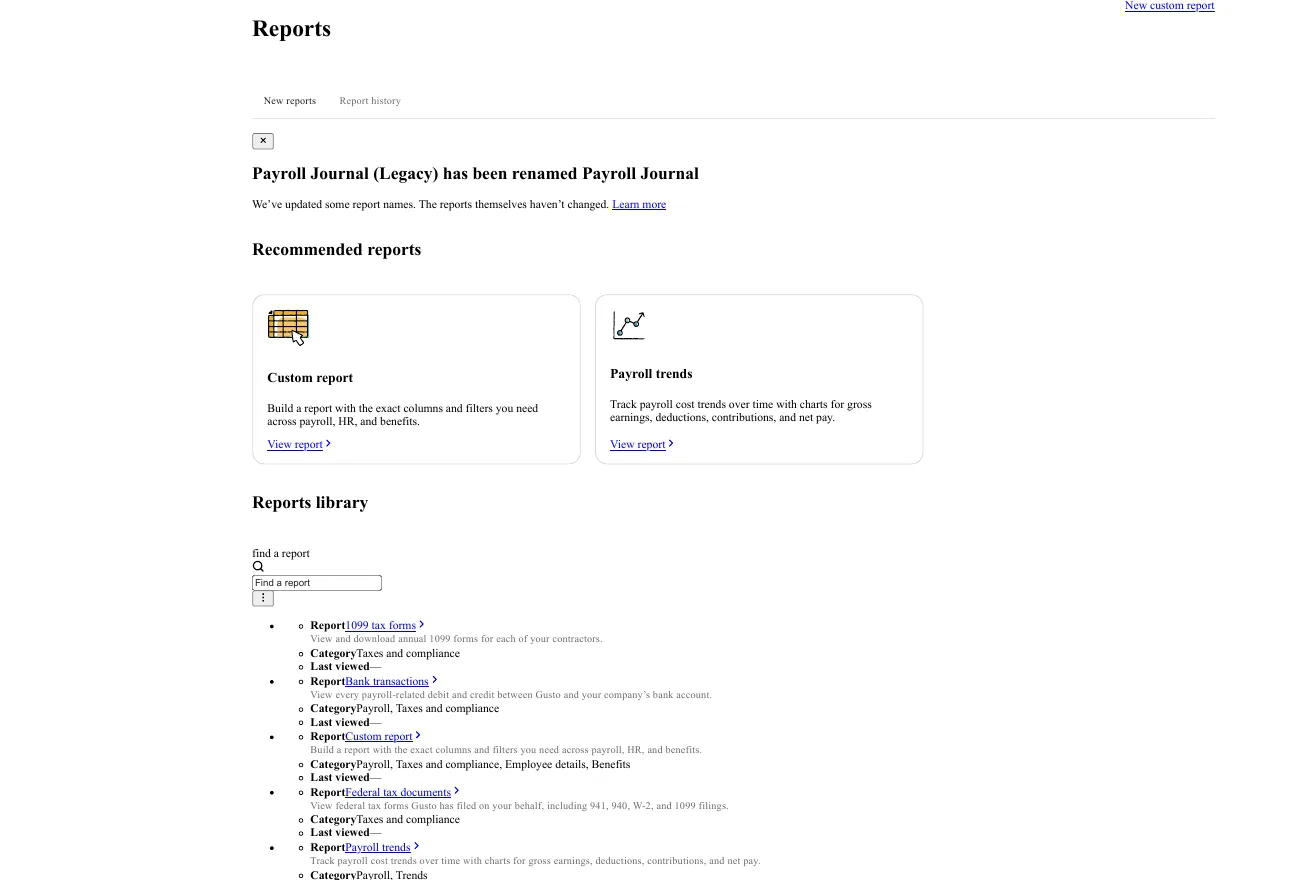 That’s the profile my 8/10 verdict was built on: transparent pricing, strong employee self-onboarding, and full-service tax filing that just runs. The alternatives below are for the reader that profile excludes: the support-sensitive, the international, the QuickBooks-bound and the budget-squeezed.
How I chose these
I only score tools I’ve tested with my own account; the process is documented in how WiserStaff tests tools. On this page that split is stark: Gusto (8/10) and Deel (8/10) are tested; OnPay, Patriot, QuickBooks Payroll, ADP Run, Paychex and Rippling are researched from their own published pages, dated, with no invented scores. Affiliate links are disclosed above this content; Deel’s is the only one on this page, Gusto carries none, and both scored the same 8/10 regardless.
Pick by the reason you’re leaving
Six exits, six picks: support (OnPay), budget (Patriot), going global (Deel), the accounting suite (QuickBooks Payroll), quote-shopping (ADP Run and Paychex), and HR-plus-IT consolidation (Rippling).
OnPay
The support exit. OnPay’s shape is deliberately Gusto-like: full-service US payroll at $49/mo + $6/worker (Payroll Essentials, per its pricing page captured April 2026, first month free), with HR as a modular add-on (+$15 base +$2/worker). Its pitch is the contrast: “transparent pricing is part of our ethos – which means no mysterious quoting process or hidden fees, ever”, plus free setup and migration. In the Reddit thread above, one business owner rated it 8/10 after three years and 18 employees, crediting US-based support. That’s a single owner’s experience, but it sits on the exact axis Gusto leavers care about. Not yet tested by me, so no score.
Patriot Payroll
The budget exit. Patriot’s pricing page (captured June 2026) lists Basic Payroll at $17/mo + $4/worker and Full Service at $37/mo + $5/worker, with extra-state filing at $12/mo per state; its payroll page claims Full Service is “chosen by 84% of customers” and carries a tax-filing reliability guarantee with free setup and migration. The same Reddit thread has a user calling its US phone support “a dream” since January 2024. It’s plain payroll rather than a benefits-and-HR platform, which is exactly how it stays cheap. If even that bill is the sticking point, the free payroll software tear-down covers the genuinely free tier below Patriot, and the tax-filing catch that comes with it. Not yet tested.
Deel
The global exit. Gusto pays US-based employees only. If the real problem is your first hire abroad, you need a global platform rather than another US payroll tool. An employer of record (EOR) is a company that legally employs staff in a country where you have no entity, handling payroll, taxes and compliance while you direct the day-to-day work; whether you need one at all versus a US PEO is a decision the EOR vs PEO guide walks you through.
Tested (Jul 2026): 8/10. I set up a real account and posted a live job through Deel’s recruiting flow. List prices: global payroll from $29/employee/mo, EOR from $599/employee/mo, US PEO $125, HR from $14/worker. The catch: platform fees sit on top of salary, employer taxes and FX. Full detail in the Deel review. → See Deel
QuickBooks Payroll
The accounting-suite exit. If your books already live in QuickBooks, Intuit sells payroll bundled with them: per its pricing page captured 10 July 2026, Payroll + Simple Start at $88/mo + $6.50/employee, Payroll + Essentials at $125/mo + $6.50, and Premium + Plus at $203/mo + $10, with 50%-off three-month promos running. Payroll-only prices sit behind an interactive picker, so I won’t quote them. The draw is one suite and one login; the trade-off is that you’re pricing the bundle, not just payroll. Not tested.
ADP Run and Paychex
The quote-shopped incumbents. Both verifiably publish no pricing (both pages opened 12 July 2026): ADP Run’s small-business page offers four packages behind “Get Pricing”, and Paychex’s comparison page is “Request Pricing” throughout. That’s not disqualifying, but it changes how you shop: get the full quote in writing and compare it against the published-price tools above. For what it’s worth, the Reddit thread’s Paychex data point ran about $10k a year against roughly $6k on Gusto for the same business, and its Paychex and Paycor mentions were anti-recommendations. That’s one business in one thread, but the numbers fit the quote-model economics. Neither tested. If Paychex is the incumbent you’re actually leaving rather than a candidate, the Paychex alternatives tear-down works the same problem from the other end.
Rippling
The consolidation exit. If payroll is only part of what you want to replace, and device management or app provisioning is the other part, the platform route is a different comparison entirely. Rippling is quote-only; third-party buyer price checks from July 2026 (not Rippling’s own list) put the core around $8/employee/mo plus a base fee, before the modules that matter. It has its own page here: the Rippling alternatives shortlist covers that market from both directions, including what Rippling really costs.
At a glance: Gusto alternatives compared
Prices are as printed on each vendor’s own pricing page, with the capture date stated. Tested scores exist only where I’ve run the tool.
| Tool | Best if | Publishes pricing? | Entry price (as printed) | My status |
|---|---|---|---|---|
| Gusto (incumbent) | Staying put fits | Yes | $49/mo +$6/person (30 Jun 2026) | Tested 8/10 |
| OnPay | Support is the issue | Yes | $49/mo +$6/worker (Apr 2026) | Researched |
| Patriot | Budget is the issue | Yes | $17/mo +$4/worker (Jun 2026) | Researched |
| Deel | The team goes global | Headline fees | Payroll $29; EOR $599 (Jul 2026) | Tested 8/10 |
| QuickBooks Payroll | You live in QuickBooks | Bundles only | $88/mo +$6.50/emp (Jul 2026) | Researched |
| ADP Run | You’ll quote-shop | No | Quote-only (12 Jul 2026) | Researched |
| Paychex | You’ll quote-shop | No | Quote-only (12 Jul 2026) | Researched |
| Rippling | HR + IT consolidation | No (quote-only) | See its own round-up | Researched |
If your team is a tipped restaurant crew, the calculus shifts enough that it has its own page: the payroll-for-restaurants round-up reruns these prices against tip credit rules and the 2026 W-2 tip reporting.
How to switch payroll providers without a mess
Switching payroll is a timing problem more than a technology problem.
- Cut at a boundary. A quarter boundary is clean; a year boundary is cleaner. Your new provider needs year-to-date figures to file W-2s correctly, and mid-quarter handovers are where filings get missed.
- Put the filing split in writing. Confirm which provider files which quarter’s federal and state returns before you cancel anything.
- Export everything first. Payroll history, tax documents and employee records, while your Gusto access is live.
- Run one cycle in parallel. Same discipline as any system move; the BambooHR switching checklist applies almost unchanged.
Which alternative should you choose?
Name your exit reason and the pick names itself: support points to OnPay, budget to Patriot, going global to Deel, QuickBooks to its own payroll bundle, quote-shopping at scale to ADP Run, and HR-plus-IT consolidation to Rippling. If no exit reason survives contact with the pricing table, my tested verdict stands: Gusto at 8/10 is a keeper for the single-state US team it was built for.
If you’d rather run the decision from scratch, the how to choose payroll software guide does it constraint first. For where payroll sits in the wider stack, see the HR automation map.
FAQ
Why are people leaving Gusto?
The recurring theme across independent review platforms is support: reviewers describe live help as hard to reach at peak periods like year-end filing, and GetApp's support sub-rating sits at 4.4 against a 4.6 overall. Cost creep with headcount and a one-external-bank-account limit come up too. The product itself still rates 4.6/5 across thousands of reviews, which matches my own 8/10 tested verdict.
Did Gusto raise its prices?
Yes. Gusto's own pricing page shows the Simple plan at $40 a month in a January 2025 capture and $49 a month by the end of April 2025, with the $6 per person fee unchanged; that's the plan most small teams start on, and it still lists at $49 plus $6 in a 30 June 2026 capture. The tested plan-by-plan breakdown is in the Gusto review on this site.
Who are Gusto's biggest competitors?
For US small-business payroll: OnPay, Patriot, QuickBooks Payroll, ADP Run and Paychex. For teams going international, the competition shifts to global platforms like Deel. Rippling competes from the all-in-one HR-and-IT side, and Justworks from the PEO route. Which one is the real competitor depends on why you're shopping.
What is the cheapest alternative to Gusto?
Among tools that publish prices, Patriot is the budget anchor: its own pricing page lists Basic Payroll at $17 a month plus $4 per worker, and Full Service at $37 plus $5, against Gusto's $49 plus $6. The trade-off is scope: Patriot is plain payroll, not the benefits-and-HR layer Gusto bundles.
Can I switch payroll providers mid-year?
Yes, but timing matters. A quarter boundary is the clean cut, and a year boundary is cleaner still, because your new provider needs year-to-date figures to file W-2s correctly. Export your payroll history first, confirm which side files which quarter's returns in writing, and run one parallel cycle before you cancel.
Gusto vs ADP: which is better for a small business?
They sell differently. Gusto publishes its prices ($49 a month plus $6 per person on Simple, per a 30 June 2026 capture) and is built for self-serve; ADP Run puts four packages behind a sales quote (page checked 12 July 2026). For a small team that wants a known bill without a call, Gusto's model fits better. At larger headcounts ADP's quote can become competitive, so get it in writing and compare it against the published prices.
Gusto vs QuickBooks Payroll: which should I pick?
Pick by where your books live. QuickBooks Payroll makes most sense bundled with QuickBooks accounting, listed at $88 a month plus $6.50 per employee with Simple Start in a 10 July 2026 capture. Gusto is the standalone payroll-and-HR route at $49 plus $6 on Simple, with stronger onboarding and benefits around it. If you're not committed to QuickBooks accounting, the bundle argument disappears.
Does Gusto work for international employees?
Not for payroll: Gusto pays US-based employees only. If the real problem is hiring outside the US, you don't need a Gusto clone; you need global payroll or an employer of record, which is a different product category with different economics. That decision has its own guide on this site.